• Hey Guest. Check out your NeoGAF Wrapped 2025 results here!

Crimson Desert - Digital Foundry - High-End PC's Biggest Visual Upgrade - Ray Reconstruction/Ray Regeneration

Yes I know, but that poster also said this:

Dude is wondering if a Pro will provide a superior experience to a fucking 5090.

He's including playing from his couch into the "experience". Like I said, visuals are not the only factor. I'm also curious about the trophies they implement. If it looks like a good platinum hunting game then I may play it on Pro myself.
 
He's including playing from his couch into the "experience". Like I said, visuals are not the only factor. I'm also curious about the trophies they implement. If it looks like a good platinum hunting game then I may play it on Pro myself.
I guess he doesn't want to plug his PC into his living room TV, but honestly the visual difference is huge in this game. It's a no brainer to go for the high end PC experience if you have access to one.
 
He's including playing from his couch into the "experience"
Shame Facepalm GIF by MOODMAN
 
He's including playing from his couch into the "experience". Like I said, visuals are not the only factor. I'm also curious about the trophies they implement. If it looks like a good platinum hunting game then I may play it on Pro myself.
He's also discarding RR as a "minor" improvement, but PSSR2 will be such a game changer that it's worth waiting for and will elevate the console experience.

I don't even know why you're giving the benefit of the doubt to this nonsense.
 
He's also discarding RR as a "minor" improvement, but PSSR2 will be such a game changer that it's worth waiting for and will elevate the console experience.

I don't even know why you're giving the benefit of the doubt to this nonsense.

Clearly I'm not reading what he is saying the same as you are. Oh well. It ain't that serious.


Come On What GIF by MOODMAN


I really don't understand what is so triggering here, but again.......oh well
 
Clearly I'm not reading what he is saying the same as you are. Oh well. It ain't that serious.


Come On What GIF by MOODMAN


I really don't understand what is so triggering here, but again.......oh well
Just be consistent. Don't dismiss RR in this game as a minor improvement, only to go and say PSSR2 will "elevate the experience" over regular PSSR.
 
Last edited:
Just be consistent. Don't dismiss RR in this game as a minor improvement, only to go and say PSSR2 will "elevate the experience" over regular PSSR.

Not going to belabor the point. I'm interested to see how much improvement PSSR 2 will bring to the table myself. Probably going to buy it on Steam for my sons either way so I'll post some side by side comparison shots in the OT if I do.
 
very interesting stuff. I wonder what the Avatar devs use. Been playing DLC and i really like the way areas are properly darkened especially when it stops raining while the skies are still dark so you get these nice specular highlights while the areas around them remain properly darkened. its very pleasing to the eye.
They do 1/4x, 1/2x or 1x depending on the quality settings. The technique itself is very similar to Yotei (using screen space and world space probes to select what rays to cast) but at 4 to 10x the ray count

A great read here:

https://media.gdcvault.com/gdc2024/...ns/Kuenlib_Quentin_Raytracing_In_Snowdrop.pdf


The gotcha is the RT looks subpar because it uses an extremely low ray count per pixel, lower than anything we've seen so far. Those are the count for the diffuse (lighting) in some games.

Cyberpunk 2077 Path Tracing: 2 rays, 1 bounce per pixel
Dragon's Dogma 2: 1/4 rays per pixel
Assassin's Creed Shadows: 1/4 rays per pixel
Crimson Desert: 1/16 rays per pixel

Fro specular (reflections)

Cyberpunk RT Ultra: 8 rays per pixel
Cyberpunk RT Psycho: 10 rays per pixel
Cyberpunk RT Overdrive: 22 rays per pixel
Assassin's Creed Shadows: 1/2 rays per pixel
Crimson Desert: 1/4 rays per pixel

So there's your catch. By far the lowest quality RT we know of so far. It explains all the noise and flickering without RR.
You may be conflating cyberpunk rt reflection numbers for RTGI specular.

Think of the Sun and a mirror in a 3D space. RTGI specular is the light the mirror reflects from the Sun back to the world. RT reflections are what the mirror reflects of the world onto itself. RTGI specular traces back to the Sun. The other traces to the camera position. Those large numbers are typical for RT reflections and will destroy any card if done for specular GI in real time.

I believe for Cyberpunk, specular GI only exists in PT.
 
Last edited:
Generally with these comparisons I'm always left feeling like the upgrade isn't worth the price of the GPUs and the hit to performance.
Like with the RE9 video they did my reaction to most of comparisons was like "that's it?"

But this seems to be a rare example where there really is, IMO, a massive improvement in almost every comparison shot they showed.

Pretty cool overall
 
They do 1/4x, 1/2x or 1x depending on the quality settings. The technique itself is very similar to Yotei (using screen space and world space probes to select what rays to cast) but at 4 to 10x the ray count

A great read here:

https://media.gdcvault.com/gdc2024/...ns/Kuenlib_Quentin_Raytracing_In_Snowdrop.pdf


You may be conflating cyberpunk rt reflection numbers for RTGI specular.

Think of the Sun and a mirror in a 3D space. RTGI specular is the light the mirror reflects from the Sun back to the world. RT reflections are what the mirror reflects of the world onto itself. RTGI specular traces back to the Sun. The other traces to the camera position. Those large numbers are typical for RT reflections and will destroy any card if done for specular GI in real time.

I believe for Cyberpunk, specular GI only exists in PT.
I don't mean RTGI specular, I mean specular reflections. This is what they call it here:

https://images.nvidia.com/aem-dam/S...lace-architecture/nvidia-ada-gpu-artistry.pdf

Upon reading more closely, it's a bit confusing. They mention ray counts for the different RT modes, but the section before highlights that the new PT makes specular reflections possible, so presumably, Ultra and Psycho do not have specular reflections, but they make no mention of the ray count for specular or how and when it changes with PT.
 
Last edited:
Correct. That's RT reflections. Then you shouldn't compare that to the 1/2 of ac shadows or the 1/4 of CD. Those numbers are for RTGI specular. Not specular reflections
Oh, never mind. This isn't even just for reflections, this is the total number of rays, including for shadows and lighting. So this tells us nothing about the exact number of rays per pixel for diffuse or specular like the AC Shadows slide.
 
Last edited:
They do 1/4x, 1/2x or 1x depending on the quality settings. The technique itself is very similar to Yotei (using screen space and world space probes to select what rays to cast) but at 4 to 10x the ray count

A great read here:

https://media.gdcvault.com/gdc2024/...ns/Kuenlib_Quentin_Raytracing_In_Snowdrop.pdf
Dude this is great. You are like an ray tracing encyclopedia with how quickly you find this stuff.

No wonder Avatar ray tracing looks so good on ultra settings on pc. its likely full resolution. This is what i was hoping Crimson Desert devs would do for PC. kinda weird that they are going with such a low resolution on all platforms and forcing ray regeneration which isnt even available on all AMD GPUs.
 
Last edited:
Dude this is great. You are like an ray tracing encyclopedia with how quickly you find this stuff.

No wonder Avatar ray tracing looks so good on ultra settings on pc. its likely full resolution. This is what i was hoping Crimson Desert devs would do for PC. kinda weird that they are going with such a low resolution on all platforms and forcing ray regeneration which isnt even available on all AMD GPUs.
Well they arent really forcing it. The game has its own denoiser, it just struggles with the low ray counts. It could be improved over time. it could be improved with the day one patch.
 
4080 or PS5 Pro, I really don't know which one to pick honestly.

RR looks amazing but how well can a 4080 run that at decent fps.

You can fiddle with settings until you get a solid frame rate. Then you have mods. It's a no brainer.
 
Last edited:
I'm always confused by people who say they have the latest 90-series card but talk about choosing between couch or desk. One generally has a decent spare PC or the money to run the cabling from a PC to a living room if they're in the high-end component demo. It's so easy to do these days with big picture mode.

Of course you will be able to use RR and have great performance on 4080. PC games are usually scalable.

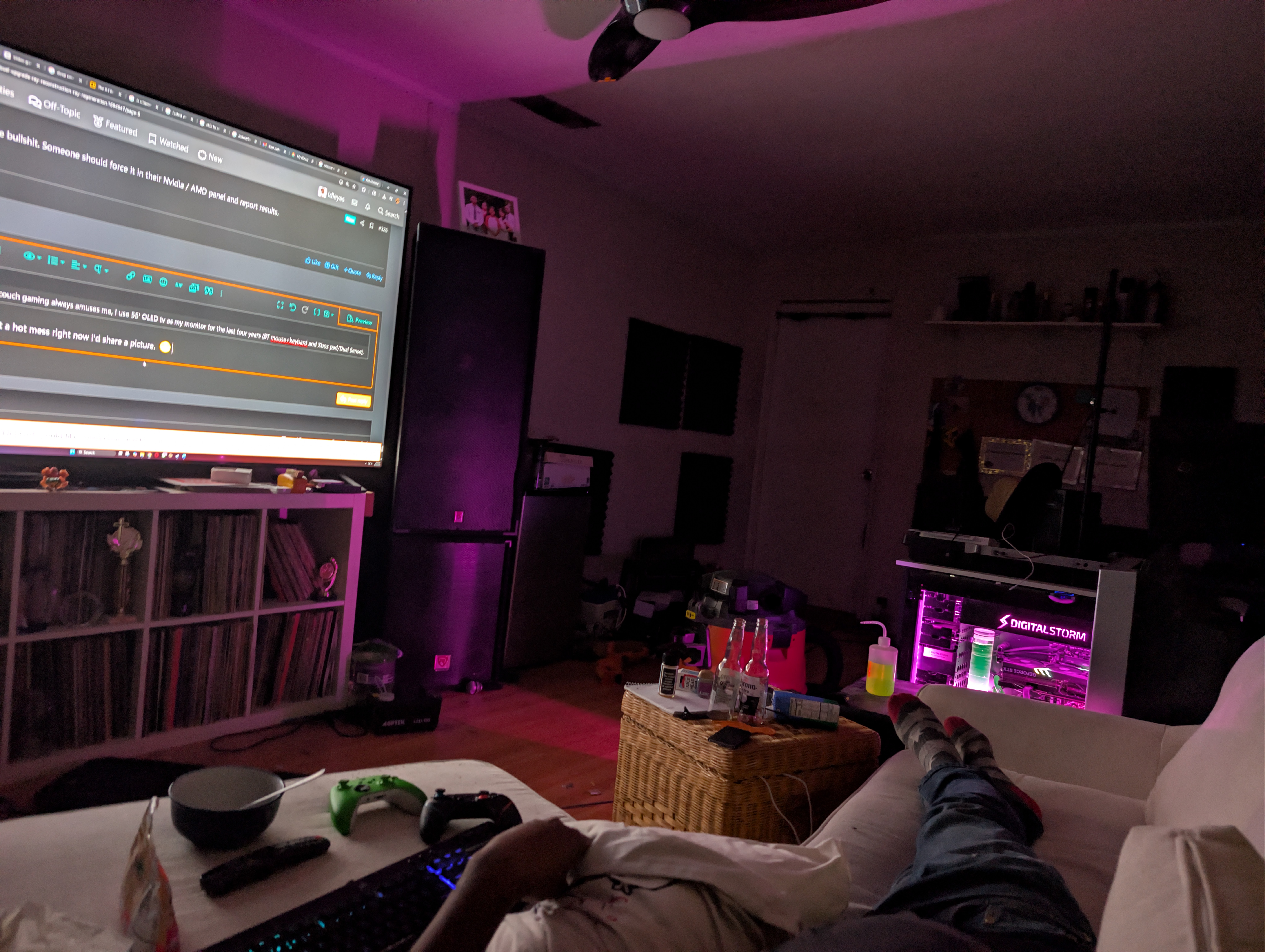
And this talk about PC =/= couch gaming always amuses me, I use 55' OLED tv as my monitor for the last four years (BT mouse+keybard and Xbox pad/Dual Sense).
While you technically can connect a PC in the living, there are more than a few reasons why it's not preferrable to do so. Here are just a few:
  1. For those with a spouse and family, the living room is a shared area and the sheer size and aesthetic of a PC can be an eye sore that doesn't pass the WAF test
  2. PC towers are not designed for a living room and it's furniture and thus won't fit in most TV stands/shelves
  3. The visual clutter that comes with a desktop, all of it's wires, and accessories goes against the clean look that many desire in their living room
  4. The noise and heat generated by a PC tower can be obnoxious and again go against the clean relaxing environment desired in a living room
  5. AV integration with components (such as TVs with HDMI CEC and AV processors) is not as seamless and stable as a console (which is designed to work with consumer electronics in the living room)
  6. Living rooms being a communal space is more common to shared game experiences (I.e local multiplayer) which PCs don't do nearly as well
  7. PCs are multifunctional and even if gaming is OK on a TV in a living room, many other PC functions aren't nearly as good in a living room TV setup.
I could go on and on but the point is that the HW and software of a PC is not designed for a living room environment whereas a console is simply a dedicated gaming PC designed for the living room. Yes technically you could game on a PC in the living room and on a console in your desktop but both would be compromised experiences.

If I works for you for your lifestyle and use case, fine. But don't act like you can't understand why someone would prefer gaming on a console in the living room. It's really not hard to understand.
 
While you technically can connect a PC in the living, there are more than a few reasons why it's not preferrable to do so. Here are just a few:
  1. For those with a spouse and family, the living room is a shared area and the sheer size and aesthetic of a PC can be an eye sore that doesn't pass the WAF test
  2. PC towers are not designed for a living room and it's furniture and thus won't fit in most TV stands/shelves
  3. The visual clutter that comes with a desktop, all of it's wires, and accessories goes against the clean look that many desire in their living room
  4. The noise and heat generated by a PC tower can be obnoxious and again go against the clean relaxing environment desired in a living room
  5. AV integration with components (such as TVs with HDMI CEC and AV processors) is not as seamless and stable as a console (which is designed to work with consumer electronics in the living room)
  6. Living rooms being a communal space is more common to shared game experiences (I.e local multiplayer) which PCs don't do nearly as well
  7. PCs are multifunctional and even if gaming is OK on a TV in a living room, many other PC functions aren't nearly as good in a living room TV setup.
I could go on and on but the point is that the HW and software of a PC is not designed for a living room environment whereas a console is simply a dedicated gaming PC designed for the living room. Yes technically you could game on a PC in the living room and on a console in your desktop but both would be compromised experiences.

If I works for you for your lifestyle and use case, fine. But don't act like you can't understand why someone would prefer gaming on a console in the living room. It's really not hard to understand.

What in the LLM are you talking about?
dTrJujRuIPsdusgV.gif
 
While you technically can connect a PC in the living, there are more than a few reasons why it's not preferrable to do so. Here are just a few:
  1. For those with a spouse and family, the living room is a shared area and the sheer size and aesthetic of a PC can be an eye sore that doesn't pass the WAF test
  2. PC towers are not designed for a living room and it's furniture and thus won't fit in most TV stands/shelves
  3. The visual clutter that comes with a desktop, all of it's wires, and accessories goes against the clean look that many desire in their living room
  4. The noise and heat generated by a PC tower can be obnoxious and again go against the clean relaxing environment desired in a living room
  5. AV integration with components (such as TVs with HDMI CEC and AV processors) is not as seamless and stable as a console (which is designed to work with consumer electronics in the living room)
  6. Living rooms being a communal space is more common to shared game experiences (I.e local multiplayer) which PCs don't do nearly as well
  7. PCs are multifunctional and even if gaming is OK on a TV in a living room, many other PC functions aren't nearly as good in a living room TV setup.
I could go on and on but the point is that the HW and software of a PC is not designed for a living room environment whereas a console is simply a dedicated gaming PC designed for the living room. Yes technically you could game on a PC in the living room and on a console in your desktop but both would be compromised experiences.

If I works for you for your lifestyle and use case, fine. But don't act like you can't understand why someone would prefer gaming on a console in the living room. It's really not hard to understand.

Have you actually done much PC gaming? I think your concerns are overstated.

1. Have you see the size and shape of a PS5? The Switch/Switch2 and the series are the only reasonably sized console. Case shape is preference with manufacturers like fractal design creating cases made to blend in with a room's decor.
2. See above. PC cases to do that exist. I also question the constraint of TV shelves because one would generally design around their requirements if they are spending on a high-end tv, sound system, high end PC, and a console. Carpentry/cabling is the cheapest part of a living room project.
3. What wires? Its power, video, and a lan port?
4. Noise is a factor with PS5/Series as well. Especially with Pro consoles. Noise is easier to control on PC since you have more cooling options.
5. CEC is an issue and needs an adapter which is annoying. Its not an insurmountable issue to resolve for a power user who is on top end cards.
6. No clue what you mean here. Local multiplayer depends on the game. PC supports a wider range of peripherals and tools like steam input make it possible to ensure anything plugged in works right. My family plays the first helldivers using a mixture of 8bitdo, Xbox, and Gamecube controllers. The Asian FGC plays locals entirely on PC. Steam also allows game-streaming so local players can mix with remote friends who don't own the game.
7. PC are better at both gaming and media which is what you would set them up anyway. My living room setup is purely entertainment.

A console is more staightforward no doubt. PC is still really easy and its challenges are immaterial if you're the type who is already spending on the best. I just beat multiple long games from my couch on PC. The experience would be indistinguishable from console if I handed you a controller mid-session. Its great.
 
While you technically can connect a PC in the living, there are more than a few reasons why it's not preferrable to do so. Here are just a few:
  1. For those with a spouse and family, the living room is a shared area and the sheer size and aesthetic of a PC can be an eye sore that doesn't pass the WAF test
  2. PC towers are not designed for a living room and it's furniture and thus won't fit in most TV stands/shelves
  3. The visual clutter that comes with a desktop, all of it's wires, and accessories goes against the clean look that many desire in their living room
  4. The noise and heat generated by a PC tower can be obnoxious and again go against the clean relaxing environment desired in a living room
  5. AV integration with components (such as TVs with HDMI CEC and AV processors) is not as seamless and stable as a console (which is designed to work with consumer electronics in the living room)
  6. Living rooms being a communal space is more common to shared game experiences (I.e local multiplayer) which PCs don't do nearly as well
  7. PCs are multifunctional and even if gaming is OK on a TV in a living room, many other PC functions aren't nearly as good in a living room TV setup.
I could go on and on but the point is that the HW and software of a PC is not designed for a living room environment whereas a console is simply a dedicated gaming PC designed for the living room. Yes technically you could game on a PC in the living room and on a console in your desktop but both would be compromised experiences.

If I works for you for your lifestyle and use case, fine. But don't act like you can't understand why someone would prefer gaming on a console in the living room. It's really not hard to understand.
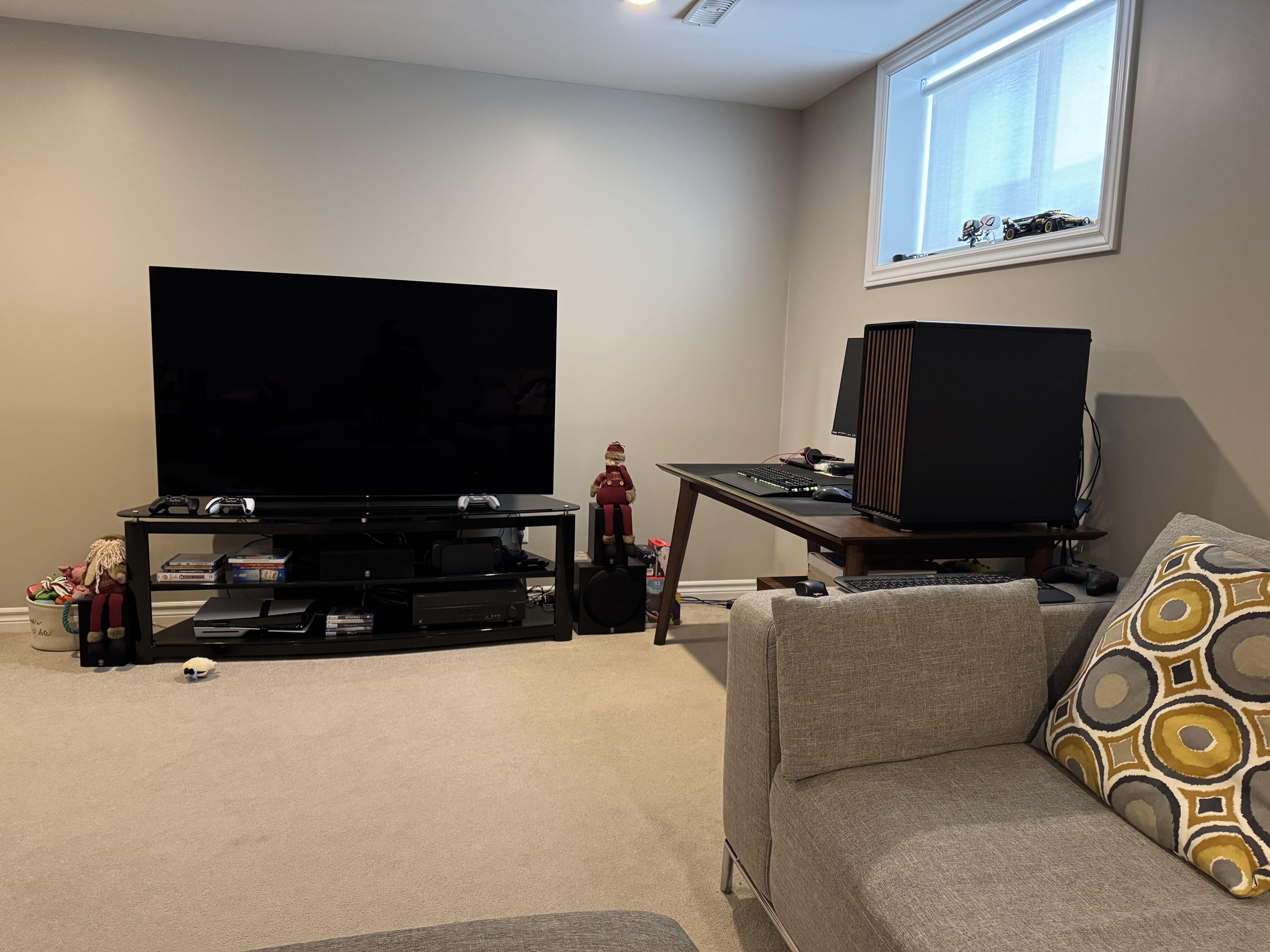
Behold my unstable TV PC gaming setup:

AOtMUSnYCufkUx7q.jpeg


Newsflash- its stable AF.
 
While you technically can connect a PC in the living, there are more than a few reasons why it's not preferrable to do so. Here are just a few:
  1. For those with a spouse and family, the living room is a shared area and the sheer size and aesthetic of a PC can be an eye sore that doesn't pass the WAF test
  2. PC towers are not designed for a living room and it's furniture and thus won't fit in most TV stands/shelves
  3. The visual clutter that comes with a desktop, all of it's wires, and accessories goes against the clean look that many desire in their living room
  4. The noise and heat generated by a PC tower can be obnoxious and again go against the clean relaxing environment desired in a living room
  5. AV integration with components (such as TVs with HDMI CEC and AV processors) is not as seamless and stable as a console (which is designed to work with consumer electronics in the living room)
  6. Living rooms being a communal space is more common to shared game experiences (I.e local multiplayer) which PCs don't do nearly as well
  7. PCs are multifunctional and even if gaming is OK on a TV in a living room, many other PC functions aren't nearly as good in a living room TV setup.
I could go on and on but the point is that the HW and software of a PC is not designed for a living room environment whereas a console is simply a dedicated gaming PC designed for the living room. Yes technically you could game on a PC in the living room and on a console in your desktop but both would be compromised experiences.

If I works for you for your lifestyle and use case, fine. But don't act like you can't understand why someone would prefer gaming on a console in the living room. It's really not hard to understand.
If couch gaming is so important to you that you have to wonder whether you should play on your $4000 PC or your $750 console, then before getting that PC, you should have made sure there was a way to game on the couch with it. Otherwise, you're an utter moron who spent thousands of dollars on something without thinking things through.
 
If couch gaming is so important to you that you have to wonder whether you should play on your $4000 PC or your $750 console, then before getting that PC, you should have made sure there was a way to game on the couch with it. Otherwise, you're an utter moron who spent thousands of dollars on something without thinking things through.

 
Have you actually done much PC gaming? I think your concerns are overstated.

1. Have you see the size and shape of a PS5? The Switch/Switch2 and the series are the only reasonably sized console. Case shape is preference with manufacturers like fractal design creating cases made to blend in with a room's decor.
2. See above. PC cases to do that exist. I also question the constraint of TV shelves because one would generally design around their requirements if they are spending on a high-end tv, sound system, high end PC, and a console. Carpentry/cabling is the cheapest part of a living room project.
3. What wires? Its power, video, and a lan port?
4. Noise is a factor with PS5/Series as well. Especially with Pro consoles. Noise is easier to control on PC since you have more cooling options.
5. CEC is an issue and needs an adapter which is annoying. Its not an insurmountable issue to resolve for a power user who is on top end cards.
6. No clue what you mean here. Local multiplayer depends on the game. PC supports a wider range of peripherals and tools like steam input make it possible to ensure anything plugged in works right. My family plays the first helldivers using a mixture of 8bitdo, Xbox, and Gamecube controllers. The Asian FGC plays locals entirely on PC. Steam also allows game-streaming so local players can mix with remote friends who don't own the game.
7. PC are better at both gaming and media which is what you would set them up anyway. My living room setup is purely entertainment.

A console is more staightforward no doubt. PC is still really easy and its challenges are immaterial if you're the type who is already spending on the best. I just beat multiple long games from my couch on PC. The experience would be indistinguishable from console if I handed you a controller mid-session. Its great.
Ok I'm not here to really argue with folks on this because like I said, if it works for you then great. But let me be clear and add context on why it's obvious that PC gaming in the living room may not be preferable and is definitely not preferable to me.

Have you actually done much PC gaming? I think your concerns are overstated
Let's just say that I've spent more time on a PC than most people. I've worked in PC gaming for nearly 20 years and I currently own a 5080OC/9950X3D PC rig including a 45" 5K OLED monitor. I've worked on the PC at every level from optimizing the GPU driver to working on UI elements in the app. Understand, you may think my concerns are overstated but they are not coming from a place of ignorance or lack of experience.

My PS5 Pro is connected in a home theater setup featuring a 100" OLED and a 13 speaker 8000W+ Dolby Atmos sound system. More importantly, I've spent a tremendous amount of time, effort, and money making sure my environment is clean, quiet, and aesthetically attractive while being functional. For example, no wires or components are visible from the the seating area, over 23 sound panels are laid around the room, and I have multiple power cleaners/filters throughout the system to make sure it's noiseless. I only provide those details to emphasize that my space is an extreme but optimal use case for a living room console.

With that said, I have never and will never hook my PC up in that setup for the reasons I mentioned and more. To be more specific to my setup:

  1. FACT: my PC tower will not fit in my 9 shelf A/V stand in which I currently have 9 components including my PS5 PRO, 3 High Powered Amplifiers, my AV Processor, and a 13 channel Power Conditioner among other things. My point is yes my PC tower is just that big that it can't fit in the rack where all of those components can. It can only fit on the door next to the stand which is not an option because like I said, that will destroy the clean look and aesthetic that I prioritize in that environment
  2. In terms of wires, I don't know what you're talking about but I literally have no less than 8 USB connections to my PC besides the display cord and power cable (peripherals like camera, microphone, headsets, RGB lights, speakers, controllers, disc drive etc). So yes, a web of wires that is a NO GO in my theater room (or living room)
  3. Maybe your PC is different, but there is no comparison of noise between the PS5 Pro and a desktop PC. Like not even close. Nobody has ever mentioned the noise of the PS5 in my room a few feet away but my wife can hear my PC kicking in from outside my office in the next room (it's quieter in general usage but when booting into a game, it's beyond jet engine)
  4. CEC and your comments on gaming and media seem to focus on flexibility and capability whereas I'm focused on no fuss functionality. Getting adaptors, third party software etc can allow you to potentially do almost anything on a PC. But stability, time, and convenience are always a concern. No fuss, no time, "just works" is what consoles offer and fits in with the comfort and ease of my living/theater room.
Bottom line, with my PS5 Pro, I can have everything in my theater completely off (Console, TV, Processor, Amplifiers etc) and with a single press on the wireless controller, I can have everything in my system automatically turn on, sync properly with each other (switch to correct inputs etc), and be back in my game from exactly where I left off in my last play session IN LESS THAN 20secs 100/100 times. There isn't a Windows PC of any spec that can replicate that experience, speed, convenience, and reliability. THAT is the value of a console and no amount of TFLOPs, adaptors, or mods, can compensate for that. Meanwhile my PC struggles to even wake up from sleep where the GPU often takes several minutes to even send a signal to my monitor.

Again, you're not wrong in saying that it's all possible to do with a PC but the experience, complexity, and execution are still leagues apart.

 
Last edited:
Ok I'm not here to really argue with folks on this because like I said, if it works for you then great. But let me be clear and add context on why it's obvious that PC gaming in the living room may not be preferable and is definitely not preferable to me.


Let's just say that I've spent more time on a PC than most people. I've worked in PC gaming for nearly 20 years and I currently own a 5080OC/9950X3D PC rig including a 45" 5K OLED monitor. I've worked on the PC at every level from optimizing the GPU driver to working on UI elements in the app. Understand, you may think my concerns are overstated but they are not coming from a place of ignorance or lack of experience.

My PS5 Pro is connected in a home theater setup featuring a 100" OLED and a 13 speaker 8000W+ Dolby Atmos sound system. More importantly, I've spent a tremendous amount of time, effort, and money making sure my environment is clean, quiet, and aesthetically attractive while being functional. For example, no wires or components are visible from the the seating area, over 23 sound panels are laid around the room, and I have multiple power cleaners/filters throughout the system to make sure it's noiseless.

With that said, I have never and will never hook my PC up in that setup for the reasons I mentioned and more. To be more specific to my setup:

  1. FACT: my PC tower will not fit in my 9 shelf A/V stand in which I currently have 9 components including my PS5 PRO, 3 High Powered Amplifiers, my AV Processor, and a 13 channel Power Conditioner among other things. My point is yes my PC tower is just that big that it can't fit in the rack where all of those components can. It can only fit on the door next to the stand which is not an option because like I said, that will destroy the clean look and aesthetic that I prioritize in that environment
  2. In terms of wires, I don't know what you're talking about but I literally have no less than 8 USB connections to my PC besides the display cord and power cable (peripherals like camera, microphone, headsets, RGB lights, speakers, controllers, disc drive etc). So yes, a web of wires that is a NO GO in my theater room (or living room)
  3. Maybe your PC is different, but there is no comparison of noise between the PS5 Pro and a desktop PC. Like not even close. Nobody has ever mentioned the noise of the PS5 in my room a few feet away but my wife can hear my PC kicking in from outside my office in the next room (it's quieter in general usage but when booting into a game, it's beyond jet engine)
And I thought the first LLM rant was stupid.. Holy shit...
 
And I thought the first LLM rant was stupid.. Holy shit...

Personally I don't care what someone's preferences are. My issue is when people act like their pristine RGB cathedral is how most gamers live. In my entire life of hanging around actual gamers, I've only seen those museum-grade setups online. Out of the, I dunno, 60 mutha fuckas I've known over the years, more than half were PC gamers and their rig was just… sitting on the floor next to the TV or monitor like a household appliance.

Edit: Forgot to mention I'm not making the claim that this is somehow the benchmark for all gamers or some shit.
 
Last edited:
Generally with these comparisons I'm always left feeling like the upgrade isn't worth the price of the GPUs and the hit to performance.
Like with the RE9 video they did my reaction to most of comparisons was like "that's it?"

But this seems to be a rare example where there really is, IMO, a massive improvement in almost every comparison shot they showed.

Pretty cool overall
The difference between RT on vs PT on in RE9 was WAY bigger than RT off vs RT on imo.
 
The lack of base model versions is becoming a bit of a worry, being held off until release? I get when someone offers you something to review, you'd be silly to not take them up on it. DF has been upfront about it being the Pro version or PC etc. If the base version release is buggy/trash/crap or just not enough then what? Should all these reviewers including DF be held accountable for their part in all this?

A reviewer should probably ask why no base version? or are they already sitting on their base version review and feel confident in it? if so, then why make them hold off. Giving into publisher/developer demands is never a good luck, especially if this goes sideways.

This is starting to feel like Cyberpunk. I hope for their sakes the base version is great. Lucky I have a pro so it doesn't impact me directly.
 
While you technically can connect a PC in the living, there are more than a few reasons why it's not preferrable to do so. Here are just a few:
  1. For those with a spouse and family, the living room is a shared area and the sheer size and aesthetic of a PC can be an eye sore that doesn't pass the WAF test
  2. PC towers are not designed for a living room and it's furniture and thus won't fit in most TV stands/shelves
  3. The visual clutter that comes with a desktop, all of it's wires, and accessories goes against the clean look that many desire in their living room
  4. The noise and heat generated by a PC tower can be obnoxious and again go against the clean relaxing environment desired in a living room
  5. AV integration with components (such as TVs with HDMI CEC and AV processors) is not as seamless and stable as a console (which is designed to work with consumer electronics in the living room)
  6. Living rooms being a communal space is more common to shared game experiences (I.e local multiplayer) which PCs don't do nearly as well
  7. PCs are multifunctional and even if gaming is OK on a TV in a living room, many other PC functions aren't nearly as good in a living room TV setup.
I could go on and on but the point is that the HW and software of a PC is not designed for a living room environment whereas a console is simply a dedicated gaming PC designed for the living room. Yes technically you could game on a PC in the living room and on a console in your desktop but both would be compromised experiences.

If I works for you for your lifestyle and use case, fine. But don't act like you can't understand why someone would prefer gaming on a console in the living room. It's really not hard to understand.
Virtually all of your complaints are solved by using a dedicated SFF PC. Nobody is forcing you to use an RGB monster in the living room. It could be the same size as a console, be nothing more than a black box, and have no other cables apart from power and HDMI, because wireless components are obviously a thing.

Some of your reasons are valid for not wanting a massive PC tower in the living room, but PCs are hardly just that.
 
Ok I'm not here to really argue with folks on this because like I said, if it works for you then great. But let me be clear and add context on why it's obvious that PC gaming in the living room may not be preferable and is definitely not preferable to me.


Let's just say that I've spent more time on a PC than most people. I've worked in PC gaming for nearly 20 years and I currently own a 5080OC/9950X3D PC rig including a 45" 5K OLED monitor. I've worked on the PC at every level from optimizing the GPU driver to working on UI elements in the app. Understand, you may think my concerns are overstated but they are not coming from a place of ignorance or lack of experience.

My PS5 Pro is connected in a home theater setup featuring a 100" OLED and a 13 speaker 8000W+ Dolby Atmos sound system. More importantly, I've spent a tremendous amount of time, effort, and money making sure my environment is clean, quiet, and aesthetically attractive while being functional. For example, no wires or components are visible from the the seating area, over 23 sound panels are laid around the room, and I have multiple power cleaners/filters throughout the system to make sure it's noiseless. I only provide those details to emphasize that my space is an extreme but optimal use case for a living room console.

With that said, I have never and will never hook my PC up in that setup for the reasons I mentioned and more. To be more specific to my setup:

  1. FACT: my PC tower will not fit in my 9 shelf A/V stand in which I currently have 9 components including my PS5 PRO, 3 High Powered Amplifiers, my AV Processor, and a 13 channel Power Conditioner among other things. My point is yes my PC tower is just that big that it can't fit in the rack where all of those components can. It can only fit on the door next to the stand which is not an option because like I said, that will destroy the clean look and aesthetic that I prioritize in that environment
  2. In terms of wires, I don't know what you're talking about but I literally have no less than 8 USB connections to my PC besides the display cord and power cable (peripherals like camera, microphone, headsets, RGB lights, speakers, controllers, disc drive etc). So yes, a web of wires that is a NO GO in my theater room (or living room)
  3. Maybe your PC is different, but there is no comparison of noise between the PS5 Pro and a desktop PC. Like not even close. Nobody has ever mentioned the noise of the PS5 in my room a few feet away but my wife can hear my PC kicking in from outside my office in the next room (it's quieter in general usage but when booting into a game, it's beyond jet engine)
  4. CEC and your comments on gaming and media seem to focus on flexibility and capability whereas I'm focused on no fuss functionality. Getting adaptors, third party software etc can allow you to potentially do almost anything on a PC. But stability, time, and convenience are always a concern. No fuss, no time, "just works" is what consoles offer and fits in with the comfort and ease of my living/theater room.
Bottom line, with my PS5 Pro, I can have everything in my theater completely off (Console, TV, Processor, Amplifiers etc) and with a single press on the wireless controller, I can have everything in my system automatically turn on, sync properly with each other (switch to correct inputs etc), and be back in my game from exactly where I left off in my last play session IN LESS THAN 20secs 100/100 times. There isn't a Windows PC of any spec that can replicate that experience, speed, convenience, and reliability. THAT is the value of a console and no amount of TFLOPs, adaptors, or mods, can compensate for that. Meanwhile my PC struggles to even wake up from sleep where the GPU often takes several minutes to even send a signal to my monitor.

Again, you're not wrong in saying that it's all possible to do with a PC but the experience, complexity, and execution are still leagues apart.
Claims to have optimised pc to the driver level but it takes more than 3 minutes to wake it up.

Awkward John Krasinski GIF by Saturday Night Live


There are solutions like fibre optic HDMI, or side loading moonlight on your TV, or even using a Nvidia shield or Xbox with moonlight, but you do you.
 
While you technically can connect a PC in the living, there are more than a few reasons why it's not preferrable to do so. Here are just a few:
  1. For those with a spouse and family, the living room is a shared area and the sheer size and aesthetic of a PC can be an eye sore that doesn't pass the WAF test
  2. PC towers are not designed for a living room and it's furniture and thus won't fit in most TV stands/shelves
  3. The visual clutter that comes with a desktop, all of it's wires, and accessories goes against the clean look that many desire in their living room
  4. The noise and heat generated by a PC tower can be obnoxious and again go against the clean relaxing environment desired in a living room
  5. AV integration with components (such as TVs with HDMI CEC and AV processors) is not as seamless and stable as a console (which is designed to work with consumer electronics in the living room)
  6. Living rooms being a communal space is more common to shared game experiences (I.e local multiplayer) which PCs don't do nearly as well
  7. PCs are multifunctional and even if gaming is OK on a TV in a living room, many other PC functions aren't nearly as good in a living room TV setup.
I could go on and on but the point is that the HW and software of a PC is not designed for a living room environment whereas a console is simply a dedicated gaming PC designed for the living room. Yes technically you could game on a PC in the living room and on a console in your desktop but both would be compromised experiences.

If I works for you for your lifestyle and use case, fine. But don't act like you can't understand why someone would prefer gaming on a console in the living room. It's really not hard to understand.

My guy still lives in the late 1990s where only PC towers exist. How's your Windows 98 holding up?
 
While you technically can connect a PC in the living, there are more than a few reasons why it's not preferrable to do so. Here are just a few:
  1. For those with a spouse and family, the living room is a shared area and the sheer size and aesthetic of a PC can be an eye sore that doesn't pass the WAF test
  2. PC towers are not designed for a living room and it's furniture and thus won't fit in most TV stands/shelves
  3. The visual clutter that comes with a desktop, all of it's wires, and accessories goes against the clean look that many desire in their living room
  4. The noise and heat generated by a PC tower can be obnoxious and again go against the clean relaxing environment desired in a living room
  5. AV integration with components (such as TVs with HDMI CEC and AV processors) is not as seamless and stable as a console (which is designed to work with consumer electronics in the living room)
  6. Living rooms being a communal space is more common to shared game experiences (I.e local multiplayer) which PCs don't do nearly as well
  7. PCs are multifunctional and even if gaming is OK on a TV in a living room, many other PC functions aren't nearly as good in a living room TV setup.
I could go on and on but the point is that the HW and software of a PC is not designed for a living room environment whereas a console is simply a dedicated gaming PC designed for the living room. Yes technically you could game on a PC in the living room and on a console in your desktop but both would be compromised experiences.

If I works for you for your lifestyle and use case, fine. But don't act like you can't understand why someone would prefer gaming on a console in the living room. It's really not hard to understand.
not sure about number 5, but for near console experience all this can be achieved with SFFC PC. there is a dedicated htpc group on reddit for living room cinema experience for example.


this build is even occupied less space than original PS5

but ofcourse, require right parts, proper planning and can be bit pricey


if you got 3D printer, you can access to more case design.

there is more variety chinese case out there available :


you can go smaller with less powerful parts like midrange CPU/GPU. i believe one of reason why Valve now can be bit confidence at bring back the Steam Machines concept is due to the boom of the small form factor PC market in the past few years.
 
Last edited:
While you technically can connect a PC in the living, there are more than a few reasons why it's not preferrable to do so. Here are just a few:
  1. For those with a spouse and family, the living room is a shared area and the sheer size and aesthetic of a PC can be an eye sore that doesn't pass the WAF test
  2. PC towers are not designed for a living room and it's furniture and thus won't fit in most TV stands/shelves
  3. The visual clutter that comes with a desktop, all of it's wires, and accessories goes against the clean look that many desire in their living room
  4. The noise and heat generated by a PC tower can be obnoxious and again go against the clean relaxing environment desired in a living room
  5. AV integration with components (such as TVs with HDMI CEC and AV processors) is not as seamless and stable as a console (which is designed to work with consumer electronics in the living room)
  6. Living rooms being a communal space is more common to shared game experiences (I.e local multiplayer) which PCs don't do nearly as well
  7. PCs are multifunctional and even if gaming is OK on a TV in a living room, many other PC functions aren't nearly as good in a living room TV setup.
I could go on and on but the point is that the HW and software of a PC is not designed for a living room environment whereas a console is simply a dedicated gaming PC designed for the living room. Yes technically you could game on a PC in the living room and on a console in your desktop but both would be compromised experiences.

If I works for you for your lifestyle and use case, fine. But don't act like you can't understand why someone would prefer gaming on a console in the living room. It's really not hard to understand.

I have a second tv for my woman

Thinking-Black-Guy-meme-1jqcf8.jpg
 
Last edited:
Top Bottom