• Hey Guest. Check out your NeoGAF Wrapped 2025 results here!

Foreign Language GAF

Grenseal

Member
Since I live in an area with a prominent Spanish speaking population, as well as for my own desire, I'm going to attempt to learn Spanish. In my first attempt, learning that other languages have gendered nouns kind of broke my brain.

If any native English speaker has learned another language, what advice would you give? What helps and what hurts?

Also any fun or interesting stories would be cool too.
 
English is my third language, people are nice when you try to speak their language. Just speak to natives. Never was fond of Duolingo or other apps.
 
English is my second language, I do dabble in japanese from time to time, but not enough to properly speak it lol.

yeah, I bet learning a language with gendered nouns would be hard...
as a native german speaker I grew up with a heavily gendered language, and I can't even fathom how it must be to learn that as a second language lol.

but I guess, don't try to make sense of it... just use the words often enough until it becomes natural.
because I think in Spanish it's like in German, where all the genders for the nouns are basically random.
the only ones in german that are following a pattern are words that use the same suffix,
like -chen... which all are neuter... which leads to the weird reality that in german, the word for girl is not female, but neuter, because it's Mädchen... so it has the chen suffix.


so, like, good luck lol. you'll need it.
 
I learn to read languages pretty easily. It's a habit I picked up being educated in Catholic schools where latin was a thing. Formal learning is always helpful. A tutor or class with an instructor to bounce basic grammar topics. Speak or write as much as possible once you have a basic grasp of grammar. It helps to train your mind to decode rather than discard foreign input. Then just practice and refine based on whatever your goal is.
 
Native English speaker here. Was fluent in Spanish growing up, but lost the ability to speak it when I was 16 due to brain trauma. Started learning Japanese 6 years ago, and it's been tons of fun. Been to Japan twice now, and being able to talk to the locals was the best.

Some things I wish I could have told myself six years ago:
  • Skip duolingo, it's pointless.
  • You can learn a new language at any age, but the older you are, the harder it'll be.
  • Immersion helps, a lot. For example, my Spotify algorithm is so fooled at this point that I only get commercials in Japanese.
  • Realistically you'll need to set aside at least a few hours a day to study. Like, with actual textbooks.
  • Speaking with others in your new language will typically yield the best results - there are website online where you get paired up with someone who is a native speaker that's trying to learn your native language, and those sessions can be really fun and extremely valuable.
 
Native English speaker - Got invited to a wedding Poland once, met a girl, got married, had a kid and now I speak Polish at an upper B2 level.

I started learning when our daughter was born. I got a massive boost because until my daughter went to school, my wife only spoke Polish with her and I only spoke English with her. So I was constantly hearing very simple words/phrases very frequently. My daughter was also watching kids shows in Polish and we had a lot of Polish children's books in the house. I did try things like Duolingo or Rosetta Stone but the stuff that actually stuck was the things I picked up in real life. I talked to myself a lot as well. Whenever I was doing something I would ask myself "Can I describe what I'm doing right now in Polish?" If I couldn't then when I got home I learned how to say it. By doing this you learn which words are most useful specifically for you to learn first. I focused more on taking in as much input as I could instead of studying grammar rules from a book. I still can't really tell you the grammar rules in Polish, at this point I just know it sounds right. I subscribed to a few Polish channels on my cable service and listened intently while my wife watched her shows. I listened to music in the car. I listened to learning material while I went for walks. Basically I created a little Polish world in my house.

After a number of years I finally started working with an online tutor to help get to the next level. I'm glad to say that I've never had a conversation with him in English. We travel to Poland every year to visit my wife's family. For the past 4-5 years, I switched and now I only speak Polish while I am there. At first my brain hurt and I was exhausted but like working a muscle on your body, I got use to it and now it is fun.

 
English is my second language
Stay away from the apps and try to watch content of the language you are trying to learn like youtube and tik tok
Speaking to natives help massively
 
For listening, speaking with good pronunciation and learning the conversational basics really fast, nothing beats the Pimsleur method. It sears language into your brain like that omelette du fromage Dexter episode.
 
I wish I knew more languages aswell, as experiencing media in their original language is always the superior choice.

Me and the missus have been playing with the thought of moving to northern Italy or northern France (yeah as a Norwegain I wouldn't survive too far south 😅). But I could never move to another country without learning their language. So I guess I'll come back to this thread to get some tips if we end up getting serious about uprooting.
 

Can't hurt to give Language Transfer's Complete Spanish a look. It's free and will give you a solid foundation to build from. It's 90 bite sized lessons that will take you around 12 hours total to complete.

I'd avoid anything that promises you'll be fluent after studying an hour a day for 30, 60, 90, etc days. They're just clickbait garbage and will set up unrealistic expectations.
 
Last edited:
You're lucky, there must be thousands of Spanish language resources for you to draw on. And some pretty decent Spanish tv shows.

I've learned Vietnamese to high B1/low B2 level, and Arabic to A2 level. My suggestion is to learn the basics yourself with a good textbook (I love learning with books, but I'm weird). Then to get further than the basics you'll need to start practising with real people (I do online Vmese speaking practice with a teacher once a week for an hour, which is really not enough - my Vmese has deteriorated somewhat since I reduced this from twice weekly), reading graded readers and practising listening. I am sure there are tons of Spanish podcasts you can use to practise listening and pronunciation, and books of Spanish short stories for beginners.

I find the hardest part about learning a language is just staying motivated. It's easy to be keen at the start, but once you get into the endless ocean of B1/B2, progress can feel glacial. And as others said, duolingo sucks. Apps like anki are useful for reviewing vocabulary. Have a dedicated workbook for your language-learning.
 
Italian was actually my first language, but I lost most of it when I entered pre-school, and now it's all garbled up with memories of French classes. If you ask me to speak Italian you'll probably end up with a bunch of words in both languages plus with English sentence structure.

My plan is when I'm done reading Twenty Years After by Dumas to look up the original French online and slowly reread it a chapter here a chapter there, with the English translation, a dictionary, and a notebook at my side. I really like this book, so it shouldn't be a chore. Then after that I wanna look up the lyrics in these French operas I've been listening to and not understanding a word of.

And then at some point I wanna do something similar for Italian. Maybe I can reread The Name of the Rose in English and Italian :pie_thinking:.
 
Last edited:
English is my third language, can understand up to 7, can speak 5, including japanese.

I did Duolingo a lot, before removing comments from users (very helpful) and their shift to AI. Now it's terrible
 
Don't be afraid of making mistakes. Just talk, OP. It doesn't matter if it's right. In fact, most people love it when you try to speak their language, even if you don't get it on the first try. (Except for the French. Don't ever talk to a French person. Just don't do it.)
 
Since I live in an area with a prominent Spanish speaking population, as well as for my own desire, I'm going to attempt to learn Spanish. In my first attempt, learning that other languages have gendered nouns kind of broke my brain.

If any native English speaker has learned another language, what advice would you give? What helps and what hurts?

Also any fun or interesting stories would be cool too.

English speaker who speaks fluent Polish and Italian.

Don't think you can learn a language on just Duolingo. It's good for picking up some words or phrases, but you need to compliment this with other sources. Also don't use text books. Learning a language isn't like learning maths or history.

If I was to give one tip, it would be to watch kids TV shows in Spanish. I mean simple stuff like Peppa Pig. This might sound bizarre, but because it's aimed at very young children, they speak slowly and use simpe words. It makes it easier for you to pick up.

You can then move onto video games in Spanish and more mature TV/films.
 
Since I live in an area with a prominent Spanish speaking population, as well as for my own desire, I'm going to attempt to learn Spanish. In my first attempt, learning that other languages have gendered nouns kind of broke my brain.

If any native English speaker has learned another language, what advice would you give? What helps and what hurts?

Also any fun or interesting stories would be cool too.

Understand the logic, then the basic rules (most used grammar rules) and high frequency vocabulary (together with the immersion)and then finally you go for the cases.

Really, get an A1 book and do some immersion (tv shows, movies, kids show are great for that). Spanish is simple enough for you to get it in no time.
 
Native English speaker - Got invited to a wedding Poland once, met a girl, got married, had a kid and now I speak Polish at an upper B2 level.

I started learning when our daughter was born. I got a massive boost because until my daughter went to school, my wife only spoke Polish with her and I only spoke English with her. So I was constantly hearing very simple words/phrases very frequently. My daughter was also watching kids shows in Polish and we had a lot of Polish children's books in the house. I did try things like Duolingo or Rosetta Stone but the stuff that actually stuck was the things I picked up in real life. I talked to myself a lot as well. Whenever I was doing something I would ask myself "Can I describe what I'm doing right now in Polish?" If I couldn't then when I got home I learned how to say it. By doing this you learn which words are most useful specifically for you to learn first. I focused more on taking in as much input as I could instead of studying grammar rules from a book. I still can't really tell you the grammar rules in Polish, at this point I just know it sounds right. I subscribed to a few Polish channels on my cable service and listened intently while my wife watched her shows. I listened to music in the car. I listened to learning material while I went for walks. Basically I created a little Polish world in my house.

After a number of years I finally started working with an online tutor to help get to the next level. I'm glad to say that I've never had a conversation with him in English. We travel to Poland every year to visit my wife's family. For the past 4-5 years, I switched and now I only speak Polish while I am there. At first my brain hurt and I was exhausted but like working a muscle on your body, I got use to it and now it is fun.
I'm actually very seriously considering moving to Poland after my wife and daughter both finish their undergrads, so this is quite interesting to me. From all my research, Poland seems to be ahead of America in almost every metric imaginable, but I wonder if you have any secret tips and tricks about the country for me? Is there anything you particularly don't like about it or miss about your native country?
 
I'm actually very seriously considering moving to Poland after my wife and daughter both finish their undergrads, so this is quite interesting to me. From all my research, Poland seems to be ahead of America in almost every metric imaginable, but I wonder if you have any secret tips and tricks about the country for me? Is there anything you particularly don't like about it or miss about your native country?
When I speak highly of Poland while I'm there I always get told "You are only here for two weeks every year. Vacationing in Poland is different than living in Poland." The more I try to do things there beyond vacationing, the more I see their point. The easiest way to explain it is that I learned how to be an adult in America. The system here isn't perfect but I know how it works and I'm pretty good at using it for what me and my family needs. The system there isn't perfect either but it works in a completely different way. Things that are easy here are frustrating there. Customer service is abysmal for example. But the opposite is true for a lot of things as well. In America you basically need money to solve all your problems. Over there, it's better to know the right person than try to buy your way out of a problem. So learning how to be an adult again is definitely something that needs to be worked on.

There are two things that I miss about America when I'm in Poland:

1. There is an absurd level of "this is the way we do it" going on in Poland. Craziest example. Apparently we were taught in America the "wrong" way to hold a fork and knife. When my wife noticed this I simply said "Oh, that's interesting. You have your way and I have mine." My wife's take is that I'm holding the fork and knife wrong and I should correct myself. lol. I would say in America we are more tolerate of "there are many ways to skin a sheep". As an American I stereotypically don't like to be told what to do. So this rubs me the wrong way. I don't like how involved the gov't is in the lives of the people in Europe in general for the same reason. But that's me.
2. I live in a small town in America. There is a certain level of friendliness with strangers and pleasantries that simply don't exist in Poland. Strangers only make small talk with you when they need to tell you that you are doing something wrong or they need to complain about something. Like how long the line you are all standing in is.

I'm definitely not trying to discourage your from moving. At some point in our lives my wife and I will at least live half the year in Poland and half the year in America. Basically snows birds but with Europe instead of Florida. As you correctly pointed out the metrics are amazing and Poland is definitely still getting even better at a remarkable rate. I would simply say for me the potential downsides don't show up in metrics. So YMMV.
 
When I speak highly of Poland while I'm there I always get told "You are only here for two weeks every year. Vacationing in Poland is different than living in Poland." The more I try to do things there beyond vacationing, the more I see their point. The easiest way to explain it is that I learned how to be an adult in America. The system here isn't perfect but I know how it works and I'm pretty good at using it for what me and my family needs. The system there isn't perfect either but it works in a completely different way. Things that are easy here are frustrating there. Customer service is abysmal for example. But the opposite is true for a lot of things as well. In America you basically need money to solve all your problems. Over there, it's better to know the right person than try to buy your way out of a problem. So learning how to be an adult again is definitely something that needs to be worked on.

There are two things that I miss about America when I'm in Poland:

1. There is an absurd level of "this is the way we do it" going on in Poland. Craziest example. Apparently we were taught in America the "wrong" way to hold a fork and knife. When my wife noticed this I simply said "Oh, that's interesting. You have your way and I have mine." My wife's take is that I'm holding the fork and knife wrong and I should correct myself. lol. I would say in America we are more tolerate of "there are many ways to skin a sheep". As an American I stereotypically don't like to be told what to do. So this rubs me the wrong way. I don't like how involved the gov't is in the lives of the people in Europe in general for the same reason. But that's me.
2. I live in a small town in America. There is a certain level of friendliness with strangers and pleasantries that simply don't exist in Poland. Strangers only make small talk with you when they need to tell you that you are doing something wrong or they need to complain about something. Like how long the line you are all standing in is.

I'm definitely not trying to discourage your from moving. At some point in our lives my wife and I will at least live half the year in Poland and half the year in America. Basically snows birds but with Europe instead of Florida. As you correctly pointed out the metrics are amazing and Poland is definitely still getting even better at a remarkable rate. I would simply say for me the potential downsides don't show up in metrics. So YMMV.
Thank you very much for this information, seriously. I truly appreciate it, and it's given me some things to think about. We're still going, but I can see how some of my more rebellious, and contentious, tendencies are going to need to be reined in for integration purposes.... perhaps it'd behoove me to start attempting to change in that way now rather than then.
 
It helps if you're interested in media from a place that speaks the language. You need some skin in the game, but it sounds like you do if you have an actual need locally.
 
Spanish is my native language, but I learned Portuguese from kindergarten through high school. I only speak Portuguese with my parents, and they always reply in Spanish, I can't speak Spanish with them, it feels awkward, but I do speak Spanish with other family members, lol. So my Spanish and Portuguese are both native-level, not portuñol, proper pronunciation in either one, people can't tell where I'm from.

I also speak Japanese (15 years in Japan) and I learned English by watching TV and through work.

At home, my wife speaks Chinese to my son, he speaks Japanese/English to me, and Japanese at kindergarten. He can pray in Spanish and knows a few short sentences to talk to his grandparents. I didn't teach him any Portuguese.

When I was a kid, I used to get mad at people for not understanding me when I switched languages, I thought everyone could do that, lol.
 
Love learning new languages. I just don't do it (anymore) if I have no real use for it. That is why my German is falling behind. There's no situation in my where I need it, apart from maybe ordering some food/drink on my way to Norway.
I speak Dutch (native), English #2, Norwegian #3 and German #4 in terms of skill as of now.

The better I get at Norwegian the more of a freebie Swedish becomes, but I wouldn't call myself a Swedish speaker. Coming from Dutch, Swedish is much harder in pronounciation.
 
English is my native language, but I've learned enough Spanish to get by if needs be and I'm learning Japanese, although I'm really struggling with reading it. I've also noticed that there's often a difference between subtitles and what's actually said, sometimes I'll be able to follow what's being said and the subs don't match. It's jarring.

PS: I've never left the British isles, so the languages are just for fun.
 
English speaker who speaks fluent Polish and Italian.

Don't think you can learn a language on just Duolingo. It's good for picking up some words or phrases, but you need to compliment this with other sources. Also don't use text books. Learning a language isn't like learning maths or history.

If I was to give one tip, it would be to watch kids TV shows in Spanish. I mean simple stuff like Peppa Pig. This might sound bizarre, but because it's aimed at very young children, they speak slowly and use simpe words. It makes it easier for you to pick up.

You can then move onto video games in Spanish and more mature TV/films.
Just for curiosity, why did you learn italian?
 
English speaker who speaks fluent Polish and Italian.

Don't think you can learn a language on just Duolingo. It's good for picking up some words or phrases, but you need to compliment this with other sources. Also don't use text books. Learning a language isn't like learning maths or history.

If I was to give one tip, it would be to watch kids TV shows in Spanish. I mean simple stuff like Peppa Pig. This might sound bizarre, but because it's aimed at very young children, they speak slowly and use simpe words. It makes it easier for you to pick up.

You can then move onto video games in Spanish and more mature TV/films.
Nice choices. I have the intention of doing Italian in addition to my Polish. Polish for my wife's heritage, Italian for mine. My wife keeps telling me that after Polish, Italian will seem like a breeze. haha.
 
Just for curiosity, why did you learn italian?

Because my wife and I love travelling to Italy. Love the food, culture, history, people. We're Italophiles.

Also compared to Polish, it was a very easy to learn.

Nice choices. I have the intention of doing Italian in addition to my Polish. Polish for my wife's heritage, Italian for mine. My wife keeps telling me that after Polish, Italian will seem like a breeze. haha.

You're wife is correct.

Polish is one of the hardest languages to learn for an English speaker with some very challenging grammar rules.

However, the same technique applies as in you just learn basic words and sentences first. Worry about grammar later.

Also, you have the same advantage as I did. Both our wives are Polish, meaning we can jump straight into practicing Polish conversations.

Are you learning both languages at once?
 
Because my wife and I love travelling to Italy. Love the food, culture, history, people. We're Italophiles.

Also compared to Polish, it was a very easy to learn.


You're wife is correct.

Polish is one of the hardest languages to learn for an English speaker with some very challenging grammar rules.

However, the same technique applies as in you just learn basic words and sentences first. Worry about grammar later.

Also, you have the same advantage as I did. Both our wives are Polish, meaning we can jump straight into practicing Polish conversations.

Are you learning both languages at once?
Haven't started Italian yet. I need to put a trip to Italy on the calendar to really motivate me to get started. For years I've been telling myself "I'll start when I'm happy with my Polish". One day I'll realize that I'll never completely be satisfied with my Polish and I should just get started with Italian.
 
zC5sIjriNG0944wA.png


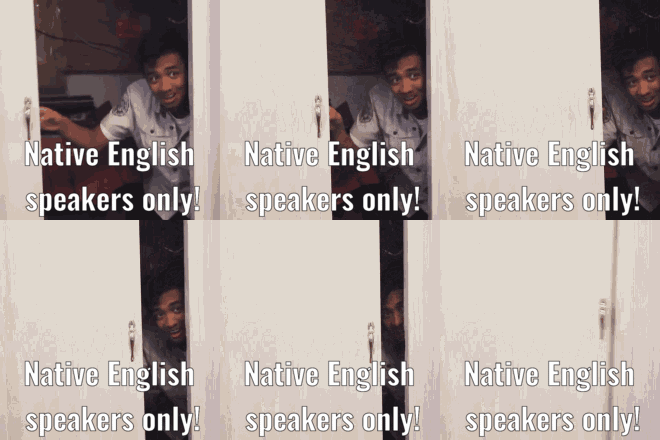
Europeans: *enter this thread happily with their multilingual skills*

Grenseal:

m8IBH7xhWqLnZVXH.gif
 
Last edited:
Was leaning Chinese for close to 10 years. Really felt rewarding. Not sure if it's still alive, but I used Skype to do exchanges, and it was incredibly helpful. Usually, I had about three appts. a week with folks I was able to establish good relationships with. One exchange was me teaching a young boy English for a half hour, and then the mother would teach me Chinese for a half hour.

Also, some simple texts (with pictures of situations) can be very helpful. Don't expect too much of yourself. And just take baby steps. Don't overload yourself. Having fun is key, in my opinion.
 
Top Bottom