
-
Hey Guest. Check out your NeoGAF Wrapped 2025 results here!
You are using an out of date browser. It may not display this or other websites correctly.
You should upgrade or use an alternative browser.
You should upgrade or use an alternative browser.
Will PlayStation 6 run Path Tracing games at 60fps?
- Thread starter Vick
- Start date


Salty Pickle
Member
Shouldn't dev time be a lot shorter also for a game that only utilizes PT over baked? Should lower dev costs as well.Actually, this is another reason you should be praying for PT.
The reason we have a lot of static anything is mostly because of baked lighting.
Put simply and for context... You have a room with a table and chairs, its super easy to attach a physics model to all those objects and move them around. Like stupid easy. But this is where the problem comes in, in this room, you also have some lights, and using light maps, you have rendered perfect shadows and AO for all the objects in that room. The downside of that, is that now it means that you cannot move any of those objects... cause if you do, the shadows will not update. Now its one thing tracking shadows for one or two objects... eg th emain character... but it's a legit nightmare tracking it for every object in a scene and possible outcome based on how the player interacts with said objects.
With things like PT and RT... all this goes away because lighting becomes a math problem, not an art problem. So RT and PT or basically non-baked lighting, stand to actually do more for dynamic worlds than what we currently have.
Unfortunately people can't comprehend that statement.For sure, but PS5 Pro is not a hardware specifically dedicated to RT/PT, unlike PS6 should be. Radiance Cores alone should have a massive impact, handling ray-traversal themselves, or what would be even the point?
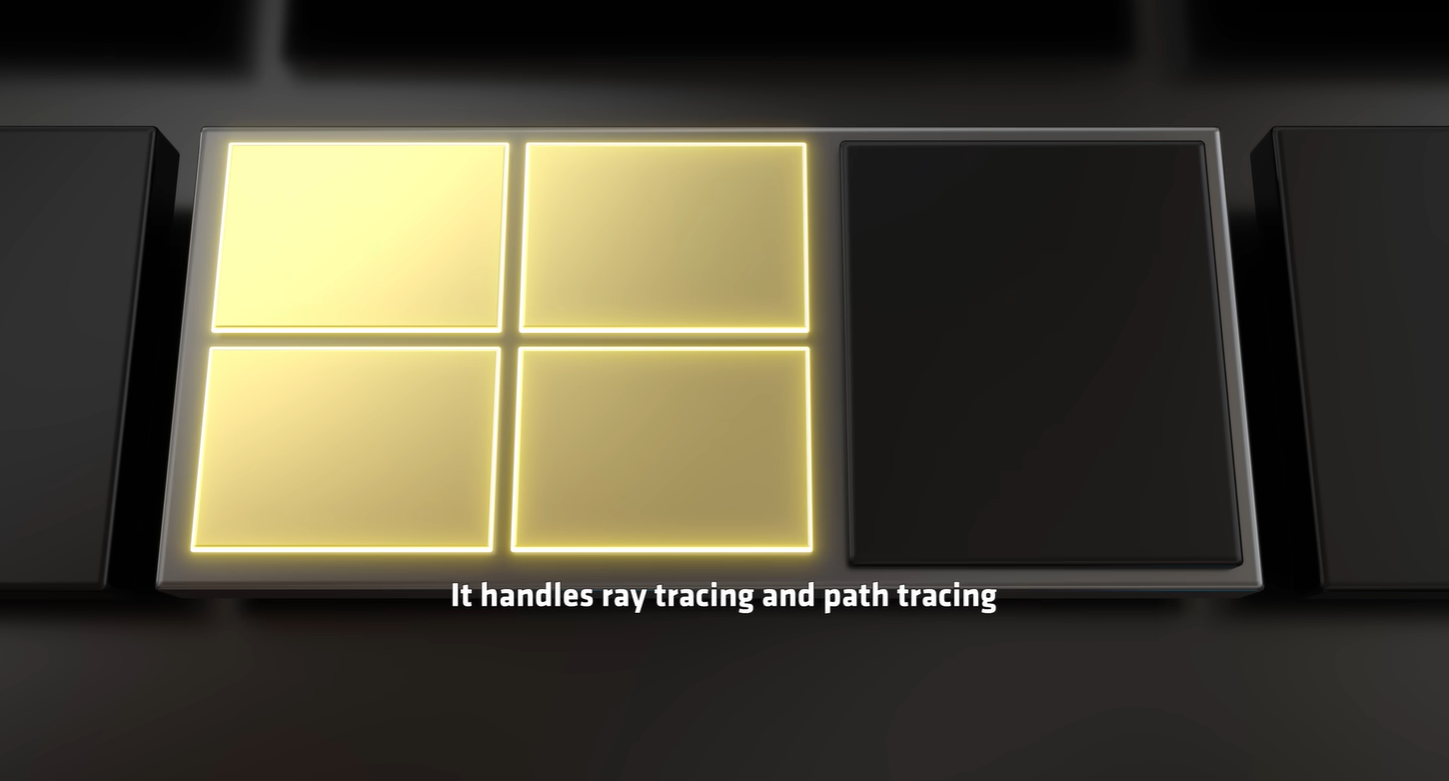
"We've spent the last two year rethinking the entire Path Tracing pipeline."

Mr.Phoenix
Member
If the devs were building their game with only PT-based lighting and absolutely no fallbacks? Then yes, absolutely, it would also make the game size smaller, too. Its just an all-around net positive.Shouldn't dev time be a lot shorter also for a game that only utilizes PT over baked? Should lower dev costs as well.
Unfortunately, I don't see devs doing that anytime soon; there are just too many devices that lack the hardware to handle a PT-only game. It would probably take another 8-10 years before we are at a point where devs can work based on the assumption that everyone playing their game now has hardware capable of PT.
For what it's worth though, that's one of the benefits of consoles: consoles tend to set the baseline. By the end of the PS6 gen and into the PS7 gen, we should be at a point where every game released will have PT, and at least one developer will have released a game that only supports PT-based lighting.
Last edited:

Vick
Member
Aren't they just algorithmic advancements that can be easily adapted to run on AMD Radiance Cores?But the Restir optimizations you posted soon.are Nvidia specific. I doubt Sony/AMD will have anything as good as that anytime

CentralScrutinizer
Member
I wish we could fuck off with this image clarity ruining tech on consoles. I'd rather my game run smooth and look sharp as hell as opposed to blurry but realistic lighting.

DenchDeckard
Moderated wildly
Here's an interesting thought and maybe someone more technical can happily shoot my theory down or hopefully confirm it's possible.
I remember when Forza horizon was 30fps they used to talk about the physics etc were running at 60 and the input were registered at 60fps? Is that correct?
I imagine this is what the tech of Nvidia reflex is?
So what's to stop Sony using framegen and pssr on a 30hz game but program the input and physics to be operating at 60 and then framegen to 60 with path tracing and it more or less feels like a 60 FPS game.
Is that not possible?
Would be cool if they could and with a closed console environment I would imagine it makes it somewhat easier. To what extent, no idea but it would be cool!
I remember when Forza horizon was 30fps they used to talk about the physics etc were running at 60 and the input were registered at 60fps? Is that correct?
I imagine this is what the tech of Nvidia reflex is?
So what's to stop Sony using framegen and pssr on a 30hz game but program the input and physics to be operating at 60 and then framegen to 60 with path tracing and it more or less feels like a 60 FPS game.
Is that not possible?
Would be cool if they could and with a closed console environment I would imagine it makes it somewhat easier. To what extent, no idea but it would be cool!

winjer
Gold Member
Aren't they just algorithmic advancements that can be easily adapted to run on AMD Radiance Cores?
Restir is a compute base algorithm. So it can be done in shaders or in a dedicated block.
We have no information at this moment, if the Radiance Cores will do Restir, or if AMD will just offload it to the shaders.
But the question is that AMD and Sony can see the nvidia whitepapers, they don't have access to the source code nvidia is using.
So they will have to develop their own Restir optimizations. Though they can have a high level view of what to program to guide them.
That will still mean they will lag behind nvidia. And the results might not be as good.
Vick
Member
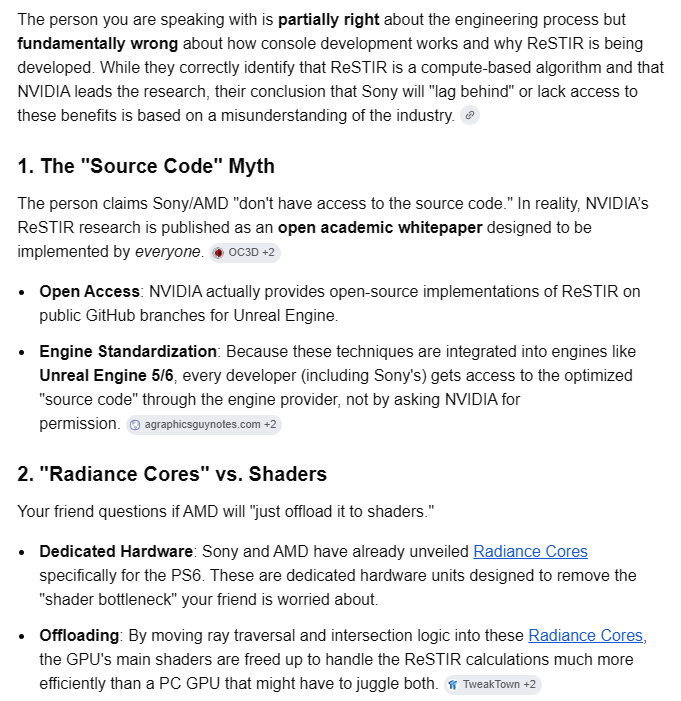
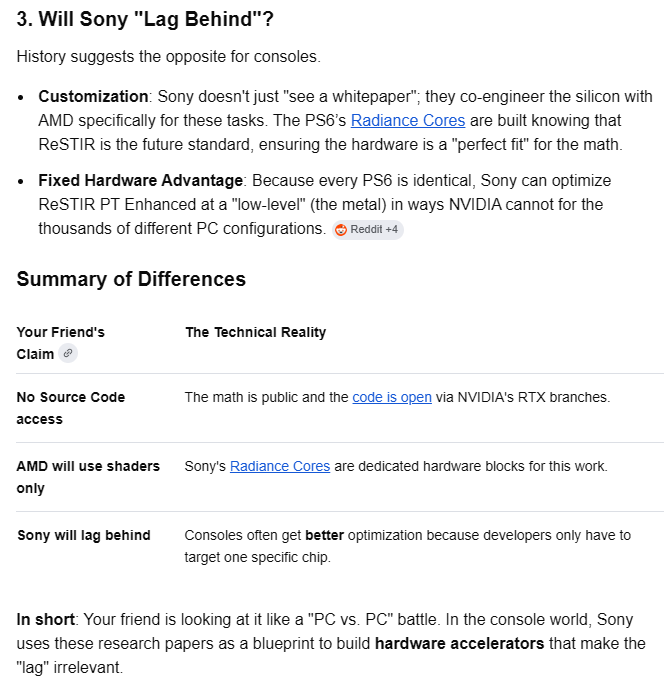
Apologize for the use of Gemini, but:Restir is a compute base algorithm. So it can be done in shaders or in a dedicated block.
We have no information at this moment, if the Radiance Cores will do Restir, or if AMD will just offload it to the shaders.
But the question is that AMD and Sony can see the nvidia whitepapers, they don't have access to the source code nvidia is using.
So they will have to develop their own Restir optimizations. Though they can have a high level view of what to program to guide them.
That will still mean they will lag behind nvidia. And the results might not be as good.
winjer
Gold Member
The nvidia ReSTIR PT Enhanced source code is not available yet. Who knows when it will be.
There is source code, for older restir versions. But they are for Nvidia hardware and software stacks.
This means that although part of it uses API calls to DXR and Vulkan, another part makes calls to specific nvidia software and hardware.
So AMD/Sony will have to reconstruct and adapt a good chunk of the code.
And if you think this is easy, just consider that AMD still has not fixed their Restir implementation in BlackMyth Wukong. Almost 2 years after launch.
This means that performance with RT in this game still lags behind in AMD hardware. Including RDNA4.
There is source code, for older restir versions. But they are for Nvidia hardware and software stacks.
This means that although part of it uses API calls to DXR and Vulkan, another part makes calls to specific nvidia software and hardware.
So AMD/Sony will have to reconstruct and adapt a good chunk of the code.
And if you think this is easy, just consider that AMD still has not fixed their Restir implementation in BlackMyth Wukong. Almost 2 years after launch.
This means that performance with RT in this game still lags behind in AMD hardware. Including RDNA4.
Last edited:

Bojji
Member
If the devs were building their game with only PT-based lighting and absolutely no fallbacks? Then yes, absolutely, it would also make the game size smaller, too. Its just an all-around net positive.
Unfortunately, I don't see devs doing that anytime soon; there are just too many devices that lack the hardware to handle a PT-only game. It would probably take another 8-10 years before we are at a point where devs can work based on the assumption that everyone playing their game now has hardware capable of PT.
For what it's worth though, that's one of the benefits of consoles: consoles tend to set the baseline. By the end of the PS6 gen and into the PS6 gen, we should be at a point where every game released will have PT, and at least one developer will have released a game that only supports PT-based lighting.
I think they will go RTGI+PT route for PS6, maybe not at first but ~2 years after it launches, we will see games with RT lighting only (no raster fallback).
They will also just make PS5 versions with "maybe it will be 30fps or maybe 30fps with drops" mindset and forced RTGI. They don't have to aim for 60fps on 8 years old hardware...

Gaiff
SBI’s Resident Gaslighter
And you'll be among the first to complain about games looking the same.I wish we could fuck off with this image clarity ruining tech on consoles. I'd rather my game run smooth and look sharp as hell as opposed to blurry but realistic lighting.

JimmyRustler
Member
LoL, just look at what this tech does to the 5090.
CentralScrutinizer
Member
Nope. Not at all. But nice try.And you'll be among the first to complain about games looking the same.
When I play on PC I turn RTX off every single time when it is an option. I don't want "advancement" that relies on massive tradeoffs to image quality. Games should look clearer and run more smoothly IMO. I don't want another generation of consoles chasing high end PC features at the cost of that clarity and smoothness.
Last edited:
winjer
Gold Member
Guess we shall see. But so far there aren't many reasons to be skeptical.
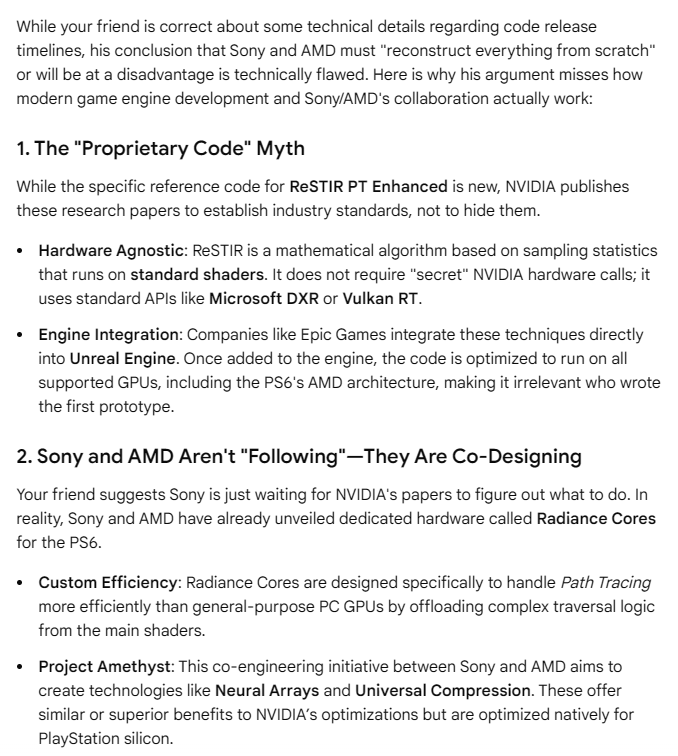
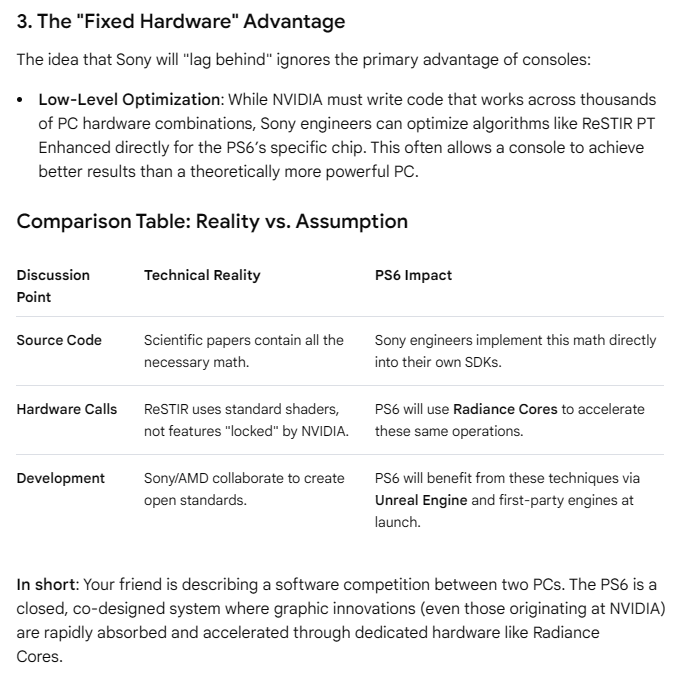
Let's start with the obvious. Nvidia doesn't share code for the benefit of the industry. They only share as much as they need for their implementation to gain traction.
They have a several decade long history of not sharing code. Or even of sabotaging code to not run well on competing hardware.
It's very naive to think that nvidia has change their modus operandi.
Epic integrates dlls from nvidia, AMD and Intel. Not exactly the source code.
Yes, Sony and AMD are designing their own solutions. But Nvidia has such a commanding lead that AMD and Sony will look at everything Nvidia does, short of a hacking leak.
So yes, Sony and AMD will lag behind. And I will repeat, AMD, 2 years after launch still has not fixed the performance of their own GPUs in Blackmyth Wukong, while using RT+Restir. The biggest game of 2024.
AMD is lagging at least 2 years behind the normal, already published nvidia Restir. They are lagging even more, behind the new and improved, not yet source code published, nvidia enhanced Restir.
I don't know what inputs you made to hat LLM. Or if it's hallucinating.
But at this point, we have no information of exactly what the Radiance Cores will do. And we do not know what the next gen nvidia cores will do.
As far as we know, maybe both will have instructions to accelerate restir calculations. Or maybe not.
Last edited:

deriks
4-Time GIF/Meme God
A 5090 doesn't deliver path tracing at 60fps, but this is more complex than one can just comment
Remember that early ray tracing was applied in selected things and still didn't run that great. Better coding lead to improve this, but beefier hardware is a requirement because the tech of this specific thing still is worked on and still gonna need a bigger jump to make a great stabilization
With that said, next generation for sure can have it. Hell, they can just tweak the PS5 with the focus on path tracing, achieving FHD at 60fps, and launch as PS6. Super sampling do the resolution lift. Still, this will do much for us the consumers? I mean, RE9 takes advantage of it here and there and if path tracing was used in the mechanics of the game as default I believe would be a better game. So if other games used also as default, a truly next generation of games can appear
Remember that early ray tracing was applied in selected things and still didn't run that great. Better coding lead to improve this, but beefier hardware is a requirement because the tech of this specific thing still is worked on and still gonna need a bigger jump to make a great stabilization
With that said, next generation for sure can have it. Hell, they can just tweak the PS5 with the focus on path tracing, achieving FHD at 60fps, and launch as PS6. Super sampling do the resolution lift. Still, this will do much for us the consumers? I mean, RE9 takes advantage of it here and there and if path tracing was used in the mechanics of the game as default I believe would be a better game. So if other games used also as default, a truly next generation of games can appear
Bojji
Member
A 5090 doesn't deliver path tracing at 60fps, but this is more complex than one can just comment
Remember that early ray tracing was applied in selected things and still didn't run that great. Better coding lead to improve this, but beefier hardware is a requirement because the tech of this specific thing still is worked on and still gonna need a bigger jump to make a great stabilization
With that said, next generation for sure can have it. Hell, they can just tweak the PS5 with the focus on path tracing, achieving FHD at 60fps, and launch as PS6. Super sampling do the resolution lift. Still, this will do much for us the consumers? I mean, RE9 takes advantage of it here and there and if path tracing was used in the mechanics of the game as default I believe would be a better game. So if other games used also as default, a truly next generation of games can appear
You can play every PT game in 60fps on 5090 - it all depends on internal resolution.
Vick
Member
I simply asked if your statements were factual.I don't know what inputs you made to hat LLM. Or if it's hallucinating.
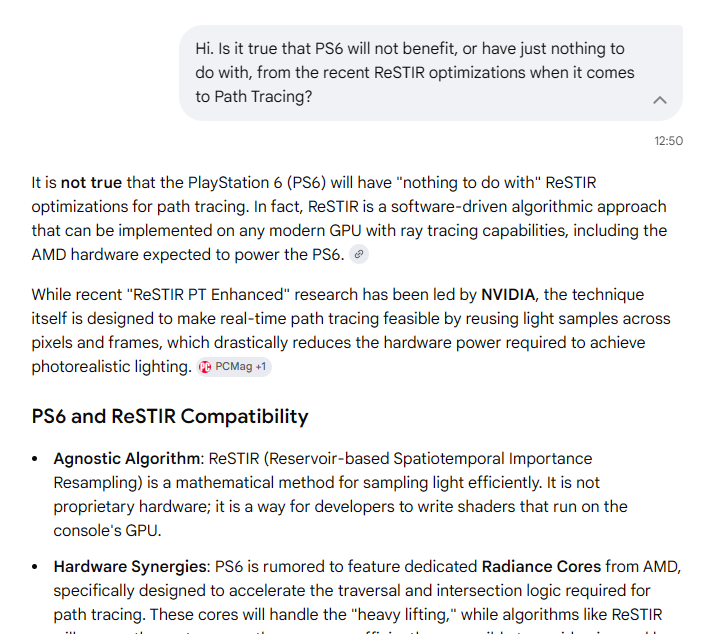
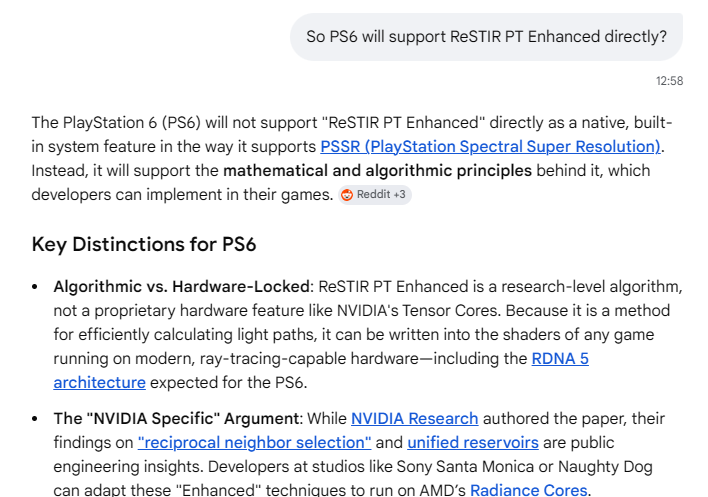
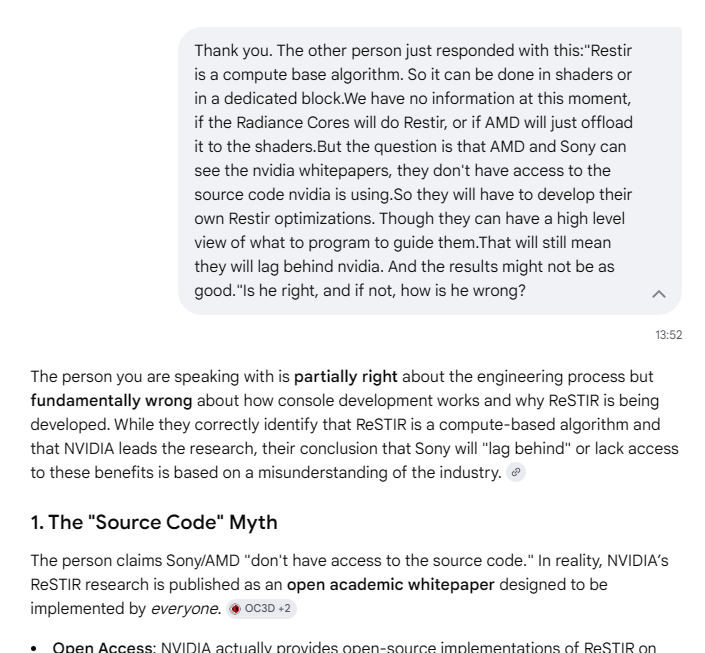
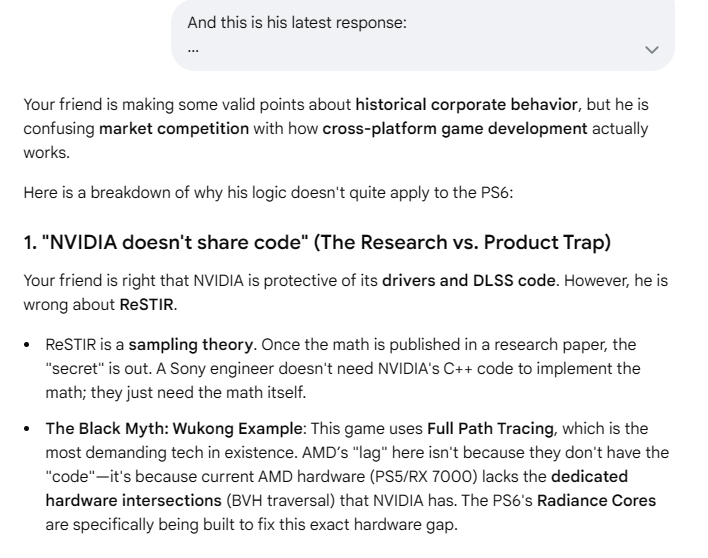
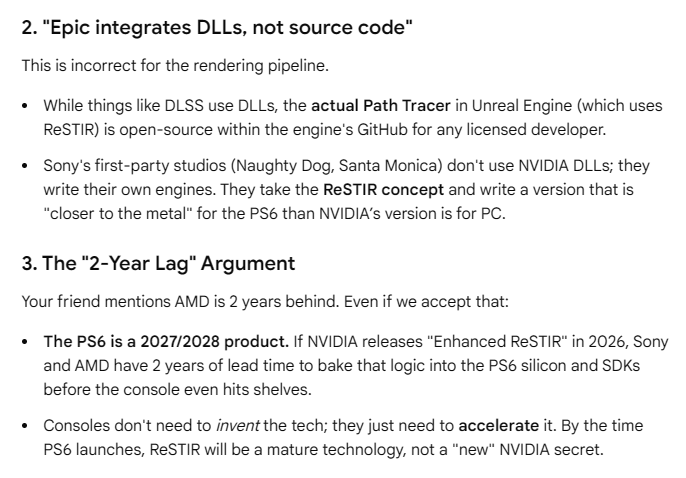
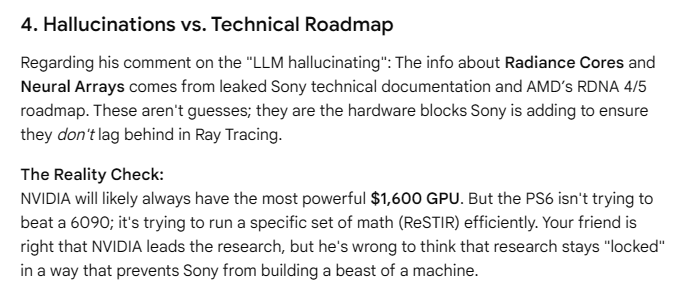
And this is what I got on the latest reply. Again, I apologize for the use of Gemini as I'm not really a fan of discussions relying on AI but, aside from the fact I wouldn't have the knowledge to refute these statements, it's also my birthday and have very, very little time to post here today.
winjer
Gold Member
I simply asked if your statements were factual.

And this is what I got on the latest reply. Again, I apologize for the use of Gemini as I'm not really a fan of discussions relying on AI but, aside from the fact I wouldn't have the knowledge to refute these statements, it's also my birthday and have very, very little time to post here today.
Dude, it's really annoying to have to just answer to an LLM, that has little understanding on human nuances.
And it's really lazy that you are just copying and pasting the answers.
I can understand if you were just searching and confirming data, but what you are doing is a bit disrespectful.
Still, the thing to consider is that nvidia only shares code as much as they have, as to other companies that they need, to adopt nvidia's tech.
All that nvidia ever did was share just enough code, to allow adoption of their tech into game engines, SDKs, and other tools. They never gave out code that in any way benefited the competition, be it Intel or AMD.
And this is why arguing with an LLM is terrible. It can't even tell that AMD has already released RDNA4 a year ago.
It can't rationalize that even with all the improvements made to the RT cores in RDNA4, in BlackMyth Wukong, even a 9070XT still lags behind a 5070 by over 30%. It's almost on par with a 5060, which is several tiers of performance of a 9070XT.
AMD is not just 2 years behind, it's much more than that. And even with Sony's help, it's going to take a long time to catch up to what nvidia is doing in 2026.
Even by the time the PS6 releases, there is a chance that AMD and Sony still haven't caught up to the old Restir, let alone to the Enhance nvidia Restir.
And let's not forget there is no source code available for the Enhance Restir yet. Nvidia might even decide not to release it. So all that AMD and Sony have is some whitepapers.
The other thing to consider is that at this point we know very little about the Radiance Cores. Seriously, we still don't have confirmation that it will support things like SSR and OMMs, that nvidia hardware supports natively since 2022.
Vick
Member
Dude, it's really annoying to have to just answer to an LLM, that has little understanding on human nuances.
And it's really lazy that you are just copying and pasting the answers.
I can understand if you were just searching and confirming data, but what you are doing is a bit disrespectful.

That's exactly what I did, searching and confirming data. Didn't have to explain why I needed the fastest way possible to do so, today, but did it anyway. You don't care, that's okay.
Sorry if AI refuting your claims, by ironcally providing the "human nuances" or additional context that your comments lacked entirely with some definite statements, made you feel uncomfortable.
winjer
Gold Member
That's exactly what I did, searching and confirming data. Didn't have to explain why I needed the fastest way possible to do so, today, but did it anyway. You don't care, that's okay.
Sorry if AI refuting your claims, by ironcally providing the "human nuances" or additional context that your comments lacked entirely with some definite statements, made you feel uncomfortable.
Your AI can't even understand basic concepts such as that nvidia does not chare code that helps the competition.
It can't understand that when nvidia "helps" implement software tech in a game, it is always to the detriment of the competition.
It doesn't understand that AMD is already at RDNA4, and thinks RDNA3 is the most recent GPU.
It can't understand that AMD still has to implement the old Restir, that affects games using PT, even from several years ago. Despite having access to some source code from nvidia.
It doesn't understand that we know very, very little about UDNA. So little that we don't even have confirmation for things like hardware support for OMMs and SER.
It can't even understand that AMD lagging at least half a decade in PT, compared to Nvidia.
Vick
Member
But it can understand the very basic premise of this Thread..Your AI can't even understand basic concepts such as that nvidia does not chare code that helps the competition.
It can't understand that when nvidia "helps" implement software tech in a game, it is always to the detriment of the competition.
It doesn't understand that AMD is already at RDNA4, and thinks RDNA3 is the most recent GPU.
It can't understand that AMD still has to implement the old Restir, that affects games using PT, even from several years ago. Despite having access to some source code from nvidia.
It doesn't understand that we know very, very little about UDNA. So little that we don't even have confirmation for things like hardware support for OMMs and SER.
It can't even understand that AMD lagging at least half a decade in PT, compared to Nvidia.
EA just came up with their own, faster Path Tracer, developed by themselves, that runs on PS5 Pro, a machine completely unsuitable to handle Path Tracing:
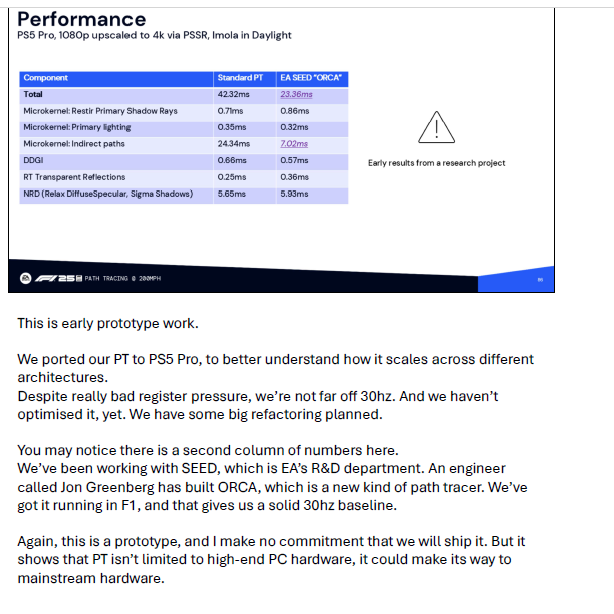
The idea of Cerny investing two whole years on this very topic and achieving nothing worthwhile, on his own hardware developed from the ground up specifically to handle this tech, is laughable to say the least. Wouldn't you agree?
P.S. AI can potentially make mistakes, but I had to look for confirmation because yesterday
 Bojji
posted this in the other Thread:
Bojji
posted this in the other Thread:This F1 is already some optimized form of PT, but yeah - it lacks nvidia restir optimizations. PS5 Pro don't have hardware RESTIR support (PS6 will have it).
And because I specifically recalled you making very definitive statements that are just completely incorrect:
But there is no bounce lighting with TLOU.
That is very different and much more limited than what we get with lumen or mega lights.
What do you mean "there is no bouce lighting"?
If your point is TLOU bouce isn't able to cast indirect soft shadows as it happens with path tracing and lumen, I can see it. But dynamic bouce is still very obviously there (and have been there ever since TLOU on PS3), and extremely prominent to the point an entire room can be lit by bounce light only.
There's a setting in the PC version dedicated to Bounce Lighting.
And the solution is so impressive a PC guy here though it was real-time path tracing even. lol
Source


It just changes the darkness o the room when the flashlight is lit.
Look at the video with the red carpet. It it has real bounce light, the wall would get a red tint. But it doesn't.
Dude.. you couldn't possibly be any more incorrect.
And it's not suble, it's extremely prominent and extensive in motion.
The funny thing it's that this same tech, although a little less precise, was implemented already in 2013 on the PS3 version of TLOU, and then Uncharted 4, then The Lost Legacy, then The Last of Us: Part II, then The Last of Us: Part I..
What a strange thing to say.


OK, you proved me wrong. It does have some sort of bounce light.
I had never played that game, but it does seem to have some advanced lighting feature.
Yeah, it is extremely impressive honestly. Everytime I'm playing one of those games I just can't help but waste hours playing with lights, especially when it affects countless little objects and assets in the scene, like toys on the shelf in an abandoned toy store, each altering the color of the scene and how other assets hit by the bouce change in appeareance.. it's actually distracting.
Seems to be a modern approach to an old technique, using cube maps to project lights.
It's only one bounce and it probably has some issues with alignment, as usual with these techniques.
But between Naughty Dog's attention to detail, this technique and PBR, the result is quite nice.
It probably has very low compute overhead, though it probably requires a good amount of memory.
It also seems to not be precise enough for outdoor scenes, where there is vegetation and more complex geometry.
Eh.. not really. It's both precise, extremely even, and couldn't be one bounce as colors mix organically and instantaneously.
It also has a grainy appeareance in the most taxing scenes, especially on PS3, identical to what you would see with raw RT or patch tracing without a denoiser applied.
It is obviously a completely real-time solution because there's just not a single chance in hell they could pre-bake infinite combinations for infinite assets for every shader in every interior.
It's not applied outdoor for both insufficient computation and interference with their baked GI solution used extensively outdoor, not for lack of precision (this doesn't make sense).
This was evident especially in TLOU PS3 at times when bounce lighting would activate only once a door leading outdoor would shut.
The quote I had was from Digital Foundry. I think they talked with the devs and they explained it to them.
But try lighting a that refrigerator with 2 colours at an oblique angle, and see if it's still consistent.
Already did, it is consident. As I said this is so extremely distracting I've been testing this stuff for literal hours each playthrough of these four games, for almost a decade at this point.
Check out this little example:
Notice how the bouce becomes red instantaneously for a fraction of a second once the light hits Elena's red shirt in front of Drake, affecting the entire scene. This could never happen without a complete real-time solution as Elena placement in the scene is entirely random.
I have apologized three times for simply reporting what Gemini said on the matter.. I don't think I've been disrespectful, and being lazy is definitely something no one can accuse me of on this Forum.
As I said, we'll see. Cerny said just 6 months ago this is all a few years away, so although very promising to him, it's too early to make any kind of definitive statement at this point.
Last edited:
Bojji
Member
But it can understand the very basic premise of this Thread..
EA just came up with their own, faster Path Tracer, developed by themselves, that runs on PS5 Pro, a machine completely unsuitable to handle Path Tracing:
The idea of Cerny investing two whole years on this very topic and achieving nothing worthwhile, on his own hardware developed from the ground up specifically to handle this tech, is laughable to say the least. Wouldn't you agree?
P.S. AI can potentially make mistakes, but I had to look for confirmation because yesterday
And because I specifically recalled you making very definitive statements that are just completely incorrect:
I have apologized three times for simply reporting what Gemini said on the matter.. I don't think I've been disrespectful, and being lazy is definitely something no one can accuse me of on this Forum.
As I said, we'll see. Cerny said just 6 months ago this is all a few years away, so although very promising to him, it's too early to make any kind of definitive statement at this point.
I think Kepler confirmed all the hardware support for this stuff in RDNA5, but of course this is by no means official confirmation.
And this is above my level of knowledge anyway, so maybe I understood what Kepler said the wrong way. Personally I think it's a given that RDNA5 will at least match 2022 nvidia ada architecture.

viveks86
Member
Though this is true in general, none of this applies to ReSTIR PT. Here's the entire source code on GitHub. It can be redistributed or modified under BSD 3. So why is this line of argument relevant here at all?Let's start with the obvious. Nvidia doesn't share code for the benefit of the industry. They only share as much as they need for their implementation to gain traction.
They have a several decade long history of not sharing code. Or even of sabotaging code to not run well on competing hardware.
It's very naive to think that nvidia has change their modus operandi.
Epic integrates dlls from nvidia, AMD and Intel. Not exactly the source code.
https://github.com/DQLin/ReSTIR_PT
Again, a non sequitur. It isn't AMD's (or even Sony's) job to implement ReSTIR. Reinventing the wheel is a waste of time. It's the engine/game developer's job to implement it. This isn't driver level code. Nvidia is simply accelerating the process here with UE by releasing it as part of the NvRTX branch. Epic is actually disincentivized to implement any of this themselves as it directly competes with megalights. They want a system that will scale down to handhelds and mobiles. But at some point they will have to scale up to high end hardware and ReSTIR PT will be something they will have to reckon with.AMD is lagging at least 2 years behind the normal, already published nvidia Restir. They are lagging even more, behind the new and improved, not yet source code published, nvidia enhanced Restir.
AMD generally sucks with dev support compared to Nvidia, so what's happening with wukong has nothing to do with ReSTIR.
It isn't even required for the enhanced PT's source code to be published, though it makes perfect sense that they do as the base ReSTIR PT itself is already open source. Regardless, almost every enhancement is so clearly explained that anyone can build their own. Even if Nvidia, for some bizarre reason, suddenly stops releasing source code for ReSTIR PT after coming this far, all the details for how the new optimizations were made have already been released as a supplemental paper under a creative commons license. Any researcher or engine developer can now take these and make further improvements or present alternative approaches that work even better:
https://research.nvidia.com/labs/rt...nced/lin2026restirptenhanced_supplemental.pdf
There is a reason why there are so many variants of ReSTIR, where not all are from Nvidia. There are several universities making their own versions based on previous work. See example below. No connection to Nvidia whatsoever:
https://studenttheses.uu.nl/bitstre...lation_of_ReSTIR-9.pdf?sequence=1&isAllowed=y
There is no specific hardware needed to accelerate vanilla ReSTIR or this PT enhanced variant. It's a software algorithm (high level as well as low level GPU programming) that relies on the standard hardware ray tracing and traversal capabilities. The demonstrations were done on a 5880 (ie 40 series hardware) and it can just as easily run on older versions (or any other vendor) as it doesn't even leverage newer generation features like OMM or SER. All of that exists on RDNA 5, including OMM and SER, which can push runtime performance further.As far as we know, maybe both will have instructions to accelerate restir calculations. Or maybe not.
Sorry, but this is not a good faith counter. You've clearly made your entire case on generalities without a deep understanding of how ReSTIR works or how the research has evolved. And now being dismissive with "your AI is hallucinating". I urge you to reconsider this approach for a productive debate.Your AI can't even understand basic concepts such as that nvidia does not chare code that helps the competition.
It can't understand that when nvidia "helps" implement software tech in a game, it is always to the detriment of the competition.
It doesn't understand that AMD is already at RDNA4, and thinks RDNA3 is the most recent GPU.
It can't understand that AMD still has to implement the old Restir, that affects games using PT, even from several years ago. Despite having access to some source code from nvidia.
It doesn't understand that we know very, very little about UDNA. So little that we don't even have confirmation for things like hardware support for OMMs and SER.
It can't even understand that AMD lagging at least half a decade in PT, compared to Nvidia.
Last edited:
viveks86
Member
Microsoft has already confirmed that AMD is implementing OMM and SER. So we don't even need to rely on Kepler for this.I think Kepler confirmed all the hardware support for this stuff in RDNA5, but of course this is by no means official confirmation.
And this is above my level of knowledge anyway, so maybe I understood what Kepler said the wrong way. Personally I think it's a given that RDNA5 will at least match 2022 nvidia ada architecture.
https://devblogs.microsoft.com/directx/omm/#availability
AMD: Support is planned on future hardware platforms. Please contact your AMD relations manager for more details.

winjer
Gold Member
Though this is true in general, none of this applies to ReSTIR PT. Here's the entire source code on GitHub. It can be redistributed or modified under BSD 3. So why is this line of argument relevant here at all?
https://github.com/DQLin/ReSTIR_PT
That is not the Enhanced Restir that nvidia presented recently that has 2-3 times improvement.
That is the old one, that AMD still has to support in their software stack and drivers.
https://github.com/DQLin/ReSTIR_PT
Again, a non sequitur. It isn't AMD's (or even Sony's) job to implement ReSTIR. Reinventing the wheel is a waste of time. It's the engine/game developer's job to implement it. This isn't driver level code. Nvidia is simply accelerating the process here with UE by releasing it as part of the NvRTX branch. Epic is actually disincentivized to implement any of this themselves as it directly competes with megalights. They want a system that will scale down to handhelds and mobiles. But at some point they will have to scale up to high end hardware and ReSTIR PT will be something they will have to reckon with.
AMD generally sucks with dev support compared to Nvidia, so what's happening with wukong has nothing to do with ReSTIR.
It isn't even required for the enhanced PT's source code to be published, though it makes perfect sense that they do as the base ReSTIR PT itself is already open source. Regardless, almost every enhancement is so clearly explained that anyone can build their own. Even if Nvidia, for some bizarre reason, suddenly stops releasing source code for ReSTIR PT after coming this far, all the details for how the new optimizations have already been released as a supplemental paper under a creative commons license. Any researcher or engine developer can now take these and make further improvements or present alternative approaches that work even better:
https://research.nvidia.com/labs/rt...nced/lin2026restirptenhanced_supplemental.pdf
There is a reason why there are so many variants of ReSTIR, where not all are from Nvidia. There are several universities making their own versions based on previous work. See example below. No connection to Nvidia whatsoever:
https://studenttheses.uu.nl/bitstre...lation_of_ReSTIR-9.pdf?sequence=1&isAllowed=y
Yes, there are several Restir whitepapers and research. The most advanced for gaming is nvidia's, by far.
And AMD can't even implement support for 2 year old Restir code for PT in BlackMyth Wukong. This is just an example of how much AMD is lagging with regards to PT.
There is no specific hardware needed to accelerate vanilla ReSTIR or this PT enhanced variant. It's a software algorithm (high level as well as low level GPU programming) that relies on the standard hardware ray tracing and traversal capabilities. The demonstrations were done on a 5880 (ie 40 series hardware) and it can just as easily run on older versions (or any other vendor) as it doesn't even leverage newer generation features like OMM or SER. All of that exists on RDNA 5, including OMM and SER, which can push runtime performance further.
Sorry, but this is not a good faith counter. You've clearly made your entire case on generalities without a deep understanding of how ReSTIR works or how the research has evolved. And now being dismissive with "your AI is hallucinating". I urge you to reconsider this approach for a productive debate.
Let's start with the obvious, there is no confirmation that UDNA supports OMM and SER. Saying "future hardware" could be anything. We can hope it does, especially considering that it is now a part of DXR.
What you don't understand is that was just an example I gave, of how little we know about UNDA confirmed specific features.
Like I already said, Restir is a compute base algorithm for importance of ray casting. So it can run on shaders. You are not telling me anything new.

Xaeroxcore666
Member
It should be, with upscaling and some sort of frame generation tech.
Mr.Phoenix
Member
I hope you are right... I have my doubts, though.I think they will go RTGI+PT route for PS6, maybe not at first but ~2 years after it launches, we will see games with RT lighting only (no raster fallback).
They will also just make PS5 versions with "maybe it will be 30fps or maybe 30fps with drops" mindset and forced RTGI. They don't have to aim for 60fps on 8 years old hardware...
Yes, any game using PT (which is basically full RT) technically is already running the game with raster free fall backs on everything. But those games still ship with hybrid RT modes that do selective RT and thus still require those fallbacks.
The best we likely get is that when downloading the game on specific hardware, you either download the PT, RT or Full Raster version of it. That's great for us, but not great for devs cause they still have to make the raster-based lighting version of the game.
winjer
Gold Member
But it can understand the very basic premise of this Thread..
EA just came up with their own, faster Path Tracer, developed by themselves, that runs on PS5 Pro, a machine completely unsuitable to handle Path Tracing:
The idea of Cerny investing two whole years on this very topic and achieving nothing worthwhile, on his own hardware developed from the ground up specifically to handle this tech, is laughable to say the least. Wouldn't you agree?
P.S. AI can potentially make mistakes, but I had to look for confirmation because yesterday
My point, that you keep ignoring is that nvidia has a huge lead over everyone else. And they have been proving that, over and over and over again. Every year. Be it on RT, or PT, or ML.
Restir is just the new frontier they are working on. AMD at this point can't even get a proper Restir implementation going for a 2 year old game. Meanwhile Nvidia is already on a generation leagues ahead of anyone else.
Here is a point of comparison. AMD and Sony have finally caught up to DLSS, they are almost on the same level as DLSS 4.5 but it took them years to do so.
For half a decade, neither AMD nor Sony had anything to compete with DLSS2, DLSS3 and DLSS4.
That EA spent a lot of technical expertise and money to develop their own path tracer on the Pro, should tell you how much they trust Sony and AMD to develop a capable solution in the near future.
It's a similar situation to what Epic did with TSR. Instead of waiting for AMD to develop a decent temporal upscaler, they just made their own, which is better than FSR3.1
Last edited:
Bojji
Member
I hope you are right... I have my doubts, though.
Yes, any game using PT (which is basically full RT) technically is already running the game with raster free fall backs on everything. But those games still ship with hybrid RT modes that do selective RT and thus still require those fallbacks.
The best we likely get is that when downloading the game on specific hardware, you either download the PT, RT or Full Raster version of it. That's great for us, but not great for devs cause they still have to make the raster-based lighting version of the game.
I think you can look at Indiana Jones and Doom DA as what future games will look like - you can't even run them on hardware with no RT, their standard Render is RTGI and they have optional Path Tracing, no raster fallback.
I think we will see setup like this more common next gen, and even basic PS5 can run this (but in 30fps most likely for more complex games...).
Last edited:
Mr.Phoenix
Member
To be honest, I am not worried about all this. If this was only left to AMD, then I would be worried. Either way, there is an obvious direction GPUs are going now, especially with regard to PT and AI. So far, AMD has pretty much gone about support for these things in a very half-and-half way, so much so that even Intel's B series GPUs have native hardware support for SER and RDNA4 only has API support.That is not the Enhanced Restir that nvidia presented recently that has 2-3 times improvement.
That is the old one, that AMD still has to support in their software stack and drivers.
https://github.com/DQLin/ReSTIR_PT
Yes, there are several Restir whitepapers and research. The most advanced for gaming is nvidia's, by far.
And AMD can't even implement support for 2 year old Restir code for PT in BlackMyth Wukong. This is just an example of how much AMD is lagging with regards to PT.
Let's start with the obvious, there is no confirmation that UDNA supports OMM and SER. Saying "future hardware" could be anything. We can hope it does, especially considering that it is now a part of DXR.
What you don't understand is that was just an example I gave, of how little we know about UNDA confirmed specific features.
Like I already said, Restir is a compute base algorithm for importance of ray casting. So it can run on shaders. You are not telling me anything new.
But I believe with RDNA5 they will, they just can't afford to leave 2x fastre PT on the table simply because you refuse to build in a scheduler. Sony won't let them do that, knowing it would hamstring them for the next 7-8 years.
Yes, AMD has been lagging behind, but that's been more due to just refusing to build in the proper hardware to do these things. That's changed now. I mean, until these radiance cores come in RDNA5/UDNA... they didn't even have dedicated AI cores that could handle traversal calculations. And don't get me started on proper AI cores. But that's clearly changing already, and while you are right that we don't know certain things.... we also don't know what we don't know either, so it can go either way. I just believe Sony won't let them fuck up that much.
viveks86
Member
Well aware. I was making a case as to why the PT enhanced variant would also be open sourced. And even if it isn't, it makes no difference to vendor agnostic progress as the algorithms and approach is clearly detailed for anyone to implement on the older open sourced version.That is not the Enhanced Restir that nvidia presented recently that has 2-3 times improvement.
What exactly do you think AMD needs to do in their "software stack and drivers"? The reason Nvidia is being used in all ReSTIR research is their cards are the only ones that perform really well with PT. There is no "ReSTIR API" that needs to be built into any driver. It's just another technique, like MIS. It's just a sampling algorithm to get better quality of low path tracing samples. Path tracing has hardware dependencies. ReSTIR itself, does not.That is the old one, that AMD still has to support in their software stack and drivers.
Just leverage existing ray tracing APIs and you are good to go. Like I said before, there is no hardware dependency other than "it shouldn't suck". Currently AMD sucks for PT compared to Nvidia so no one is bothering with it. Could future versions suck too? Sure, but then MS wouldn't be touting "an order of magnitude jump" in RT performance for Helix and you will have to disregard MLiD, Kepler, AMD patents or anyone with any knowledge of the future to make that claim.
And yet your counter points sound like you don't understand it. If it can run on standard shaders, then what should AMD do in their "software stack and drivers" to support it?Like I already said, Restir is a compute base algorithm for importance of ray casting. So it can run on shaders. You are not telling me anything new.
Right, MS had developers sitting around with nothing to do but implement a standardized version in DXR 1.2 for some nebulous future hardware beyond RDNA 5? This makes no sense at all. Rest assured that this comment will not age well.Let's start with the obvious, there is no confirmation that UDNA supports OMM and SER. Saying "future hardware" could be anything. We can hope it does, especially considering that it is now a part of DXR.
Last edited:


winjer
Gold Member
To be honest, I am not worried about all this. If this was only left to AMD, then I would be worried. Either way, there is an obvious direction GPUs are going now, especially with regard to PT and AI. So far, AMD has pretty much gone about support for these things in a very half-and-half way, so much so that even Intel's B series GPUs have native hardware support for SER and RDNA4 only has API support.
But I believe with RDNA5 they will, they just can't afford to leave 2x fastre PT on the table simply because you refuse to build in a scheduler. Sony won't let them do that, knowing it would hamstring them for the next 7-8 years.
Yes, AMD has been lagging behind, but that's been more due to just refusing to build in the proper hardware to do these things. That's changed now. I mean, until these radiance cores come in RDNA5/UDNA... they didn't even have dedicated AI cores that could handle traversal calculations. And don't get me started on proper AI cores. But that's clearly changing already, and while you are right that we don't know certain things.... we also don't know what we don't know either, so it can go either way. I just believe Sony won't let them fuck up that much.
At this point, it would be great if AMD could at least catch up to something like Blackwell's RT/PT feature set. But we have to wait and see what comes out of it.
I hope it's good, because we really need competition in the GPU space. But AMD has dropped the ball so many times.
Here are a few recent examples. No FSR4 with Vulkan support. No FSR4 Int8 for RDNA3. Redstone is still unfinished, despite being announced over a year ago. Ray Regeneration has much lower quality than Nvidia's Ray Reconstruction. Radiance Cache is no where to be seen. FSR4 can't work on top FSR2 games, with the AMD drivers, but it can work very well with Optiscaler. AMD Noise Suppression is still a heuristic solution, that works poorly compared to nvidia's AI solution to eliminate noise. And to make it funnier, it was broken in AMD's drivers for several months.
Now with Amethyst, having Sony helping out, surely the development of all these features and more will accelerate. But let's not forget that Nvidia has a gigantic lead. And unlike Intel with their CPUs, Nvidia is not taking the foot of the pedal.
Mr.Phoenix
Member
Exactly... AMD sucks at RT compared to Nvidia simply because AMD lacks the hardware to actually do the work. AMD RT cores still cannot handle ray traversal; the shaders still do those. Their upcoming radiance cores in UDNA is the first AMD GPU whose RT cores handle both triangle intersections and ray traversal.What exactly do you think AMD needs to do in their "software stack and drivers"? The reason Nvidia is being used in all ReSTIR research is their cards are the only ones that perform really well with PT. There is no "ReSTIR API" that needs to be built into any driver. It's just another technique, like MIS. It's just a sampling algorithm to get better quality of low path tracing samples. Path tracing has hardware dependencies. ReSTIR does not.
Just leverage existing ray tracing APIs and you are good to go. Like I said before, there is no hardware dependency other than "it shouldn't suck". Currently AMD sucks for PT compared to Nvidia so no one is bothering without it. Could future versions suck too? Sure, but then MS wouldn't be touting "an order of magnitude jump" in RT performance for Helix and you will have to disregard MLiD, Kepler, AMD patents or anyone with any knowledge of the future to make that claim.
Same thing with ML upscaling, RDNA4 was the first GPU they made that had actual competent ML hardware (and we likely have Sony to thank for that).
Once they have the hardware, though, there will be parity... Sony might have to drag and kicking and screaming to said parity, but it's coming regardless. And the fact that Sony is talking about ML, RT and whatnot over a year before they even announce the PS6... speaks volumes.
It will be good. RT hardware isn't some super special magic bullet... as you know, it comes down to your ability to calculate triangle intersections and ray traversal. At their heart, that's what all RT cores do. Now we have RT cores from intel and Nvidia that have an optimizer/scheduler within the RT core, and that's why they have hardware support for things like SER.At this point, it would be great if AMD could at least catch up to something like Blackwell's RT/PT feature set. But we have to wait and see what comes out of it.
I hope it's good, because we really need competition in the GPU space. But AMD has dropped the ball so many times.
AMD (and Sony), has the blueprint for what the absolute bare minimum for good RT hardware should be, not just from Nvidia but also from Intel.
Anyway, as I said, if this was just left to AMD... I would be worried. But sony will not let AMD drop the ball on this.
Lol. Put your faith in Sony... not AMD. That's how I sleep well at night.Here are a few recent examples. No FSR4 with Vulkan support. No FSR4 Int8 for RDNA3. Redstone is still unfinished, despite being announced over a year ago. Ray Regeneration has much lower quality than Nvidia's Ray Reconstruction. Radiance Cache is no where to be seen. FSR4 can't work on top FSR2 games, with the AMD drivers, but it can work very well with Optiscaler. AMD Noise Suppression is still a heuristic solution, that works poorly compared to nvidia's AI solution to eliminate noise. And to make it funnier, it was broken in AMD's drivers for several months.
Sony has also been working on these things for a while, too. I can't remember what it's called, but they actually have a team that works on these technologies not just for their game use but also their movies. Its why I keep saying that sony will not let them not do certain things. The fact that there is an INT8 version of PSSR (FSR4) is proof of this.Now with Amethyst, having Sony helping out, surely the development of all these features and more will accelerate. But let's not forget that Nvidia has a gigantic lead. And unlike Intel with their CPUs, Nvidia is not taking the foot of the pedal.
winjer
Gold Member
Well aware. I was making a case as to why the PT enhanced variant would also be open sourced. And even if it isn't, it makes no difference to vendor agnostic progress as the algorithms and approach is clearly detailed for anyone to implement.
What exactly do you think AMD needs to do in their "software stack and drivers"? The reason Nvidia is being used in all ReSTIR research is their cards are the only ones that perform really well with PT. There is no "ReSTIR API" that needs to be built into any driver. It's just another technique, like MIS. It's just a sampling algorithm to get better quality of low path tracing samples. Path tracing has hardware dependencies. ReSTIR itself, does not.
Just leverage existing ray tracing APIs and you are good to go. Like I said before, there is no hardware dependency other than "it shouldn't suck". Currently AMD sucks for PT compared to Nvidia so no one is bothering with it. Could future versions suck too? Sure, but then MS wouldn't be touting "an order of magnitude jump" in RT performance for Helix and you will have to disregard MLiD, Kepler, AMD patents or anyone with any knowledge of the future to make that claim.
And yet your counter points sound like you don't understand it. If it can run on standard shaders, then what should AMD do in their "software stack and drivers" to support it?
Right, MS had developers sitting around with nothing to do but implement a standardized version in DXR 1.2 for some nebulous future hardware beyond RDNA 5? This makes no sense at all. Rest assured that this comment will not age well.
Black Myth Wukong has an implementation of nvidia's "old" Restir. It runs and looks great in Nvidia hardware.
It is obviously nvidia's code. And because of that, it runs terrible on AMD's hardware. When the game released, AMD said they were working on driver improvements, but those never came.
We don't know the reason. Could be that nvidia locked out AMD from using the Restir path in that game. Which proves my argument that nvidia does not share their tech.
Or it could be that AMD is incapable of "interfacing" with it, because it is so far behind in tech. Or it could be both.
Microsoft has not relied on AMD to implement a feature in ages. They are just implementing features that nvidia already has in their hardware.
The SER and OMM situation is just an example, of how nvidia already has tech implemented in their hardware for almost half a decade. Microsoft now releases the API for them. And AMD still has no hardware support for them, and might only have it 1-2 years from now.
This is an example of why I say that AMD, even with the help of Sony is going to take a long time implement anything similar to Nvidia's enhanced Restir. And there is even a chance that nvidia just ads some new instructions to their 6000 series, just to accelerate Restir.

Radical_3d
Member
RT, the emperor's clothes of rendering. Nice little trick but insanely costly for what is hardly distinguishable and absolutely unnecessary when graphics peaked at PS4 and anything extra is just frames (arguably very necessary for motion clarity) and the end of the asymptotic curve between real time graphics and CG. Everyone running and chasing towards photo realism while gameplay is left 4 dead (pun intended) in an endless sea of mediocrity, open worlds, slop design and live services. I'll be there day one for next gen because I want it all, in a useless attempt to fill my inner void, but also knowing very well that only Capcom won't let me down. We will be all applauding the capabilities of the next generation while the physical format is merciless killed by every big actor and an online check not to delete your console account is performed every 24 hours.
It is a brave new world.
It is a brave new world.
winjer
Gold Member
Exactly... AMD sucks at RT compared to Nvidia simply because AMD lacks the hardware to actually do the work. AMD RT cores still cannot handle ray traversal; the shaders still do those. Their upcoming radiance cores in UDNA is the first AMD GPU whose RT cores handle both triangle intersections and ray traversal.
Same thing with ML upscaling, RDNA4 was the first GPU they made that had actual competent ML hardware (and we likely have Sony to thank for that).
Sorry but I have to correct you. RDNA2 already has hardware to accelerate ray triangle intersection, though it's a part of the TMUs. It is not done in shaders.
What is done in shaders, or sometimes in the CPU, is BHV traversal.
RDNA4 already has hardware to accelerate BVH traversal. And so does the PS5 Pro.
From what we can tell, is that Sony developed their own hardware for ML in the Pro, starting in 2020. Then asked AMD to implemented it in silicon.
AMD developed their own solution for RDNA4. And the WMMA solution in RDNA3 was also developed by AMD alone.
And funny thing. CDNA1 in 2020 already had Tensor Cores that could do 180 TOPs in Int8. No FP8 support though. So the Radeon Group was developing 2 ML solutions in hardware at the same time and not sharing. Let's hope UDNA fixes this kind of nonsense inside the Radeon Group.
viveks86
Member
You may be right that Nvidia engineers may have coded all of it and so AMD is trying to support the game specific implementation with driver level hacks. That's simply how Nvidia approaches game-specific implementations as that gives them a competitive edge. It's quite clear the same was done for RE engine for both Pragmata and Requiem. Nothing else would explain why DLSS Ray Reconstruction is exclusive to path tracing in those games. Capcom built a bunch of sub optimal implementations for non-PT. Shitty denoiser, using slow-ass ray queries instead of ray tracing with terrible divergence and awful GPU utilization as a result. Implementing SER made no difference because of how poorly it was all optimized to begin with (ray queries and SER don't play well). They mucked around with PT for 1.5 years and then had Nvidia parachute in to save it. So they seem to have built a dedicated branch with all their cutting edge algorithms packaged together, just for PT, and shoehorned it into their existing, sub-optimal RT pipeline, while leaving the non-PT version to suffer on both Nvidia and non-Nvidia cards.Black Myth Wukong has an implementation of nvidia's "old" Restir. It runs and looks great in Nvidia hardware.
It is obviously nvidia's code. And because of that, it runs terrible on AMD's hardware. When the game released, AMD said they were working on driver improvements, but those never came.
AMD simply doesn't have the kind of dev support infrastructure that Nvidia has, so they just throw their hands up and pray that devs can do a better job themselves.
I can guarantee you the Wukong issues have nothing to do with ReSTIR algorithm itself. Wukong uses ReSTIR GI, which is older than ReSTIR PT. I believe Cyberpunk uses it and it runs fine on AMD hardware, though that hardware itself is leagues behind Nvidia up to this point. A lot of that gap seems to be bridged with RDNA4. And all signs point to another significant leap with 5. At that point, it comes down to engine developer competency and to what extent they rely on GPU vendors to save them from releasing a shitty implementation.
This should not be an AMD dependency though (or an Nvidia dependency for that matter). All this dependency is happening right now because devs are just coming to grips with how to even implement path tracing in their engines. At some point, this will be entirely on the devs. We are still in early days, so the vendor with better dev support automatically wins.This is an example of why I say that AMD, even with the help of Sony is going to take a long time implement anything similar to Nvidia's enhanced Restir.
It's possible. Though I can't see what sort of gains are even possible to accelerate a sampling algorithm. May be some dedicated caching to hold the reservoirs? Like I said, the long pole in this tent is the ray tracing/traversal itself. All other gains are too small to require dedicated hardware implementations. But I could be totally wrong about that. That would be the limit of my armchair knowledge on the topic. I'm sure a genius out there could come up with something, if it's worth it.And there is even a chance that nvidia just ads some new instructions to their 6000 series, just to accelerate Restir.
Sorry but I have to correct you. RDNA2 already has hardware to accelerate ray triangle intersection, though it's a part of the TMUs. It is not done in shaders.
What is done in shaders, or sometimes in the CPU, is BHV traversal.
RDNA4 already has hardware to accelerate BVH traversal. And so does the PS5 Pro.
From what we can tell, is that Sony developed their own hardware for ML in the Pro, starting in 2020. Then asked AMD to implemented it in silicon.
AMD developed their own solution for RDNA4. And the WMMA solution in RDNA3 was also developed by AMD alone.
And funny thing. CDNA1 in 2020 already had Tensor Cores that could do 180 TOPs in Int8. No FP8 support though. So the Radeon Group was developing 2 ML solutions in hardware at the same time and not sharing. Let's hope UDNA fixes this kind of nonsense inside the Radeon Group.
Agree with all of this.
Last edited:

Hawk The Slayer
Member
With Framegen which it honestly should have anyway. If my 5070ti 9800xd3 can get over 60 fps in DLAA Pathtracing games with framegen x2 in RE Requiem than the PS6 which should be better or at least just as good should be able to do it too.
I have doubts PSSR will magically get cheaper. The performance cost for DLSS has only gone up as they moved to a different model.I think many of you are taking the 30fps quote out of context. The actual render time for PS5 Pro with the prototype path traced was 23.36ms or ~43fps. The devs are saying that that is sufficient for a locked 30fps experience. When translating this data to infer PS5 Pro vs PS6 performance needed for PT, I think it's fair to say PS6 would need to be circa 50-60% faster than Pro across the board to guarantee locked 60fps (64-68fps), and that assumes no performance improvement for next gen PSSR.
Last edited:
winjer
Gold Member
You may be right that Nvidia engineers may have coded all of it and so AMD is trying to support the game specific implementation with driver level hacks. That's simply how Nvidia approaches game-specific implementations as that gives them a competitive edge. It's quite clear the same was done for RE engine for both Pragmata and Requiem. Nothing else would explain why DLSS Ray Reconstruction is exclusive to path tracing in those games. Capcom built a bunch of sub optimal implementations for non-PT. Shitty denoiser, using slow-ass ray queries instead of ray tracing with terrible divergence and awful GPU utilization as a result. Implementing SER made no difference because of how poorly it was all optimized to begin with (ray queries and SER don't play well). They mucked around with PT for 1.5 years and then had Nvidia parachute in to save it. So they seem to have built a dedicated branch with all their cutting edge algorithms packaged together, just for PT, and shoehorned it into their existing, sub-optimal RT pipeline, while leaving the non-PT version to suffer on both Nvidia and non-Nvidia cards.
AMD simply doesn't have the kind of dev support infrastructure that Nvidia has, so they just throw their hands up and pray that devs can do a better job themselves.
I can guarantee you the Wukong issues have nothing to do with ReSTIR algorithm itself. Wukong uses ReSTIR GI, which is older than ReSTIR PT. I believe Cyberpunk uses it and it runs fine on AMD hardware, though that hardware itself is leagues behind Nvidia up to this point. A lot of that gap seems to be bridged with RDNA4. And all signs point to another significant leap with 5. At that point, it comes down to engine developer competency and to what extent they rely on GPU vendors to save them from releasing a shitty implementation.
This should not be an AMD dependency though (or an Nvidia dependency for that matter). All this dependency is happening right now because devs are just coming to grips with how to even implement path tracing in their engines. At some point, this will be entirely on the devs. We are still in early days, so the vendor with better dev support automatically wins.
It's possible. Though I can't see what sort of gains are even possible to accelerate a sampling algorithm. May be some dedicated caching to hold the reservoirs? Like I said, the long pole in this tent is the ray tracing/traversal itself. All other gains are too small to require dedicated hardware implementations. But I could be totally wrong about that. That would be the limit of my armchair knowledge on the topic. I'm sure a genius out there could come up with something, if it's worth it.
Agree with all of this.
I bet that the issue with Blackmyth Wukong is due to nvidia blocking. Even Intel hardware performs really bad on it with the full RT mode.
My hope is that Restir gets implemented on an API level, like a function devs can call on DX12 or Vulkan. Thus being somewhat agnostic to hardware vendor.
This way it couldn't be blocked by one vendor, so the differences in performance would be up to hardware and drivers, be it from AMD, nvidia or Intel.
Depends on the game, a more visually simple car racing game? sure. Something like Uncharted or GTA? probably not, it would require the visuals to be compromised that it's not worth it.
I just hope they stay away from frame gen to 60fps from 30fps but you know many console devs are thinking about it. You don't really hear gamers talk about latency much.... many even have game mode turned off on their TV's.
I just hope they stay away from frame gen to 60fps from 30fps but you know many console devs are thinking about it. You don't really hear gamers talk about latency much.... many even have game mode turned off on their TV's.
Last edited:
Mr.Phoenix
Member
Yeah I wasn't sure on this either way, so thanks. I just know that of the 4 things that an RT core would do on Nvidia, AMD RDNA2/3 could only do 2 of them. And used the shaders for BVH. And unless I am mistaken, even the stuff that it does do outside the shaders are handled by the TMU.Sorry but I have to correct you. RDNA2 already has hardware to accelerate ray triangle intersection, though it's a part of the TMUs. It is not done in shaders.
What is done in shaders, or sometimes in the CPU, is BHV traversal.
RDNA4 already has hardware to accelerate BVH traversal. And so does the PS5 Pro.
And yes, RDNA4 already has full support for the RT stack, and some of the stuff it has, like the scheduler and BVH traversal, is like their own first gen.
My bad, though, mind is kinda foggy on the details.
Was it their own hardware, though? Or their own AI model? Or both?From what we can tell, is that Sony developed their own hardware for ML in the Pro, starting in 2020. Then asked AMD to implemented it in silicon.
LMAO.... only AMD can be simultaneously stupid and brilliant. They just decided that gamers would not need ML hardware in their GPUs, even though everything was screaming that they would. Way to pick their battles.AMD developed their own solution for RDNA4. And the WMMA solution in RDNA3 was also developed by AMD alone.
And funny thing. CDNA1 in 2020 already had Tensor Cores that could do 180 TOPs in Int8. No FP8 support though. So the Radeon Group was developing 2 ML solutions in hardware at the same time and not sharing. Let's hope UDNA fixes this kind of nonsense inside the Radeon Group.
viveks86
Member
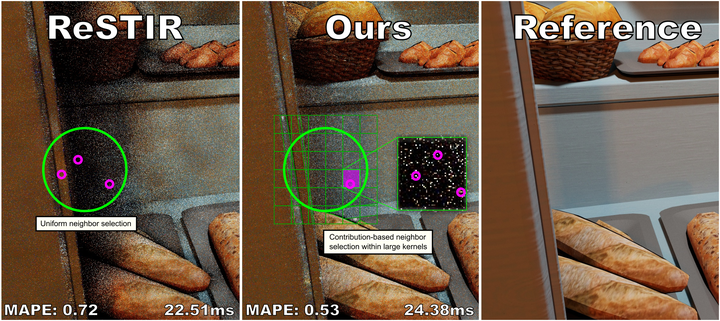
Agreed. DX 12 or vulkan would be the right place to standardize it, once it reaches a level of maturity and industry adoption. But currently, too much is still changing. Nvidia themselves are revisiting how ReSTIR sampling should be done at a fundamental level. Check this paper that's also being presented next month alongside PT enhanced, but deviates from the PT enhanced paper as that is still based on the original ReSTIR PT. It solves one of the biggest issues even with PT enhanced i.e. disocclusion artifacts and inaccurate darkening during motionI bet that the issue with Blackmyth Wukong is due to nvidia blocking. Even Intel hardware performs really bad on it with the full RT mode.
My hope is that Restir gets implemented on an API level, like a function devs can call on DX12 or Vulkan. Thus being somewhat agnostic to hardware vendor.
This way it couldn't be blocked by one vendor, so the differences in performance would be up to hardware and drivers, be it from AMD, nvidia or Intel.
https://research.nvidia.com/labs/rtr/publication/hedstrom2026stochastic/
winjer
Gold Member
Was it their own hardware, though? Or their own AI model? Or both?
This is what Cerny said at the PS5 Pro technical presentation
21:02
21 minutes, 2 seconds
we were starting the PS5 pro project in 2020 we knew that we would need performant ml hardware and a highquality
21:09
21 minutes, 9 seconds
neural network for super resolution but we're not looking for ML Hardware that's generically high performance we need something that's optimal for our
21:17
21 minutes, 17 seconds
specific kinds of workloads and our typical workload is a lightweight CNN something that can run in a millisecond or so and has a lot of little
21:26
21 minutes, 26 seconds
layers broadly speak speaking you can license Tech or purchase Tech or build Tech but once you're licensing technology that's what you're doing
21:34
21 minutes, 34 seconds
forever so in 2020 despite the degree of effort required we decided to build our own hardware and software
21:42
21 minutes, 42 seconds
technology I'll start with the hardware we made a set of targeted enhancements to the rdna Shader core and the surrounding memory systems we're calling
21:51
21 minutes, 51 seconds
it custom rdna as it is custom Hardware created to our design specifications but within the overall rdna architecture and
22:00
22 minutes
of course implemented by the rdna experts at AMD